When selecting an air compressor tank, understanding the differences between vertical and horizontal orientations is vital, as each offers unique benefits tailored to specific operational needs. These choices impact space utilization, maintenance, and system integration, ultimately influencing performance and longevity. To optimize your setup, it’s essential to analyze how these configurations align with your space constraints and system demands—considerations that can greatly affect your overall efficiency.
Key Takeaways
- Vertical tanks save space and are ideal for confined areas, with easier access for maintenance and better heat dissipation.
- Horizontal tanks are suitable for larger capacities, offering stable installation and easier integration into open or wall-mounted setups.
- Vertical tanks facilitate quicker inspection and cleaning, enhancing operational efficiency and safety.
- Horizontal tanks distribute weight more evenly for larger volumes, supporting system stability in open space installations.
- Material quality and corrosion resistance are vital for both orientations to ensure durability and long-term safety.
What Are Vertical and Horizontal Air Compressor Tanks?
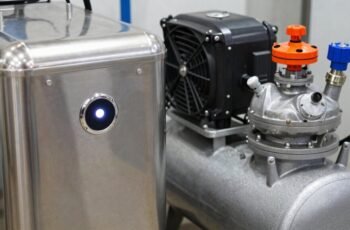
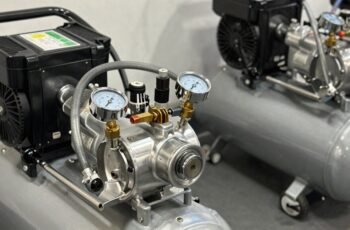
Vertical and horizontal air compressor tanks are two primary configurations designed to store compressed air, each with distinct structural and space-efficient advantages. Vertical tanks are characterized by their upright orientation, which allows for a smaller footprint, making them ideal for limited spaces. Their design promotes better stability and easier access to drain valves at the bottom. Horizontal tanks, on the other hand, are laid out in a linear fashion, providing a broader base that can accommodate larger volume capacities. They are typically easier to install in larger, open areas and facilitate easier maintenance due to their horizontal layout. Both configurations serve specific operational needs, but their structural differences influence installation, space utilization, and maintenance procedures considerably.
Key Advantages of Vertical Air Compressor Tanks
The design of vertical air compressor tanks offers several notable advantages that make them a practical choice for many applications. Their vertical orientation optimizes space efficiency by occupying a smaller footprint, especially in confined areas. This orientation also promotes better natural convection, aiding in heat dissipation and reducing the risk of overheating during operation. Additionally, vertical tanks generally experience less stress on structural components due to the distribution of internal pressure along the tank’s height, which can enhance durability and longevity. Maintenance access is often simplified because of the tank’s orientation, allowing easier inspection and cleaning. Overall, the vertical configuration combines space-saving benefits with improved thermal management and structural resilience, making them a reliable choice for diverse industrial and commercial environments.
Why Choose Horizontal Air Compressor Tanks?
Horizontal air compressor tanks are advantageous for space optimization, especially in constrained environments, as their design allows for efficient placement along walls or in corners. They also facilitate easier maintenance due to their accessibility and straightforward component layout. These factors make horizontal tanks a practical choice for streamlined operation and serviceability.
Space Optimization Benefits
Choosing horizontal air compressor tanks offers significant space optimization advantages, particularly for facilities with limited or irregularly shaped areas. Their low-profile design allows for efficient utilization of floor space, enabling installations in tight or awkward locations that vertical tanks might not accommodate. Horizontally oriented tanks can be integrated into existing layouts with minimal disruption, often fitting beneath overhead structures or alongside machinery. Additionally, their footprint can be reduced by selecting tanks with appropriate dimensions, maximizing available workspace. This configuration also facilitates easier placement of ancillary components, such as filters and regulators, around the tank. Overall, horizontal tanks promote a more compact, organized setup, enabling facilities to optimize spatial resources while maintaining system capacity and efficiency.
Ease of Maintenance
Because they typically have a lower profile and a more accessible orientation, horizontal air compressor tanks simplify routine maintenance tasks. Their design allows easier access to drain valves, filters, and drain pans, reducing downtime and potential errors. Horizontal tanks facilitate straightforward inspection and cleaning, as components are more reachable without the need for specialized tools or equipment.
Key advantages include:
- Accessible drain valves for efficient moisture removal.
- Ease of filter replacement due to straightforward access points.
- Simplified internal inspection of tank walls and components, minimizing maintenance time.
Comparing Space Requirements and Portability
Vertical and horizontal tanks differ significantly in space efficiency, with vertical models occupying less floor space in confined areas. Portability considerations also vary, as horizontal tanks tend to be more stable and easier to move with handles or wheels, while vertical tanks are often more challenging to relocate. Analyzing these factors helps determine the most suitable tank orientation based on available space and mobility needs.
Space Efficiency Differences
Have you considered how the orientation of an air compressor tank impacts its spatial footprint and portability? Vertical and horizontal tanks differ markedly in space efficiency.
- Vertical tanks occupy less horizontal space, making them suitable for tight or confined environments.
- Horizontal tanks, due to their length, require more floor area but can be easier to position alongside equipment.
- In terms of stability, vertical tanks often need a sturdy base, while horizontal tanks distribute weight evenly, potentially reducing foundation requirements.
These differences influence not only installation and space management but also operational flexibility. Vertical tanks maximize vertical space utilization, ideal for limited floor plans, whereas horizontal tanks may demand more room but offer easier access and maintenance. Analyzing these traits helps optimize spatial planning.
Portability Considerations
When evaluating air compressor tanks for portability, the choice between vertical and horizontal orientations considerably influences their mobility and handling. Vertical tanks tend to occupy less floor space, making them easier to maneuver in tight environments. Their compact design facilitates lifting and transport, especially when combined with lightweight construction. Conversely, horizontal tanks generally require more space due to their extended footprint, which can hinder movement in confined areas. While horizontal models may be more stable when stationary, their bulkiness presents challenges during relocation. Portability also depends on additional features such as handles, wheels, and overall weight distribution. Ultimately, selecting the appropriate orientation hinges on balancing space constraints, ease of transport, and operational mobility requirements.
Maintenance and Accessibility Considerations
How do the design orientations of air compressor tanks influence their maintenance and accessibility? Vertical tanks typically offer easier access to valves and drain plugs due to their upright position, facilitating routine maintenance. Horizontal tanks, however, may require additional space and strategic positioning to reach internal components efficiently.
The key considerations include:
- Accessibility of drain valves and pressure relief valves, which are often more straightforward in vertical tanks.
- Ease of inspecting and cleaning internal surfaces, typically simpler in vertical orientations due to their shape.
- Space requirements for maintenance tasks, with horizontal tanks possibly demanding more clearance for internal access.
Understanding these factors helps optimize maintenance workflows and ensures safety during servicing, regardless of tank orientation.
Which Tank Orientation Is Best for Your Application?
Selecting the appropriate tank orientation hinges on the specific requirements of your application, including space constraints, maintenance needs, and operational efficiency. Vertical tanks are advantageous in environments with limited floor space, as they occupy less horizontal area and facilitate easier installation in tight spaces. They also promote better natural convection, which can enhance cooling efficiency. Conversely, horizontal tanks offer broader surface area for heat dissipation and easier access for certain maintenance tasks, making them suitable for applications requiring frequent inspections or repairs. The choice also depends on the system’s pressure and volume demands; larger capacity needs often favor horizontal configurations for stability and weight distribution. Ultimately, evaluating your facility’s spatial layout and operational priorities guides the best orientation choice for your specific compressed air system.
Factors to Consider When Selecting an Air Compressor Tank
Choosing the right air compressor tank involves evaluating several key factors that directly impact system performance and longevity. First, consider the tank capacity, which determines the volume of compressed air available and influences cycling frequency. Second, assess the material and construction quality, as durability and corrosion resistance affect long-term reliability. Third, evaluate the tank orientation—vertical or horizontal—based on space constraints and maintenance access. Additional considerations include pressure ratings to guarantee compatibility with your system’s operating requirements, and the integration with existing equipment. By analyzing these factors, we can select a tank optimized for efficiency, safety, and durability, preventing premature failure and ensuring consistent performance in demanding applications.
Frequently Asked Questions
How Does Tank Shape Influence Air Compressor Efficiency?
Tank shape affects efficiency by influencing space utilization, heat dissipation, and maintenance ease. We analyze these factors to optimize airflow, minimize energy loss, and guarantee reliable operation, tailoring compressor selections to specific applications for maximum performance.
Are Vertical Tanks More Prone to Corrosion Than Horizontal Tanks?
Vertical tanks aren’t inherently more prone to corrosion than horizontal ones; however, their design can cause water accumulation, increasing rust risk. Proper drainage and maintenance are essential, regardless of tank orientation, to prevent corrosion and guarantee longevity.
What Are the Safety Concerns Specific to Each Tank Orientation?
Vertical tanks often pose stability risks if not properly anchored, while horizontal tanks can be more vulnerable to damage from impact or falling objects. Both orientations require careful inspection, maintenance, and safety measures tailored to their specific structural risks.
How Do Installation Costs Compare Between Vertical and Horizontal Tanks?
Installation costs for vertical tanks are generally lower due to easier setup and less space requirements, while horizontal tanks may incur higher costs due to complex foundation needs. We find that initial expenses often tip the scales.
Can Tank Orientation Affect the Lifespan of an Air Compressor System?
Tank orientation can influence the compressor’s lifespan by affecting vibration levels and sediment buildup. We find that vertical tanks reduce stress on components and facilitate drainage, potentially extending system durability, while horizontal tanks may require more maintenance to mitigate these issues.
Conclusion
In choosing between vertical and horizontal tanks, we see that the right decision hinges on space, capacity, and maintenance needs. As the saying goes, “know your tools,” because understanding your system’s demands guarantees peak performance and longevity. Both orientations offer unique advantages, so carefully evaluate your application requirements. When you align your choice with these factors, you’re not just selecting a tank—you’re setting the foundation for reliable, efficient compressed air system operation.