Few topics are as critical yet as complex as choosing between high pressure and standard air compressors, and the stakes could hardly be higher for industrial efficiency and safety. The distinctions in design, operation, and application are fundamental, yet they often go unnoticed until a costly mistake is made. Understanding these differences is essential, but the decision isn’t always straightforward—there’s much more beneath the surface that could influence your choice. Let’s explore what truly sets these compressors apart.
Key Takeaways
- High-pressure compressors deliver air above 300 psi, suitable for industrial, testing, and extreme applications, while standard compressors operate at 100-150 psi for general tasks.
- High-pressure units are more complex, costly, and require rigorous safety protocols, unlike simpler, more affordable standard compressors.
- Standard compressors are ideal for routine applications like pneumatic tools, tire inflation, and HVAC, whereas high-pressure models suit specialized industrial uses.
- Regular safety inspections and handling procedures are critical for both, but high-pressure systems demand stricter safety measures due to higher risks.
- Choosing between them depends on required pressure levels, airflow needs, application complexity, and long-term operational costs.
What Are High Pressure and Standard Air Compressors?
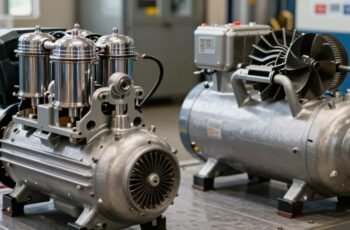
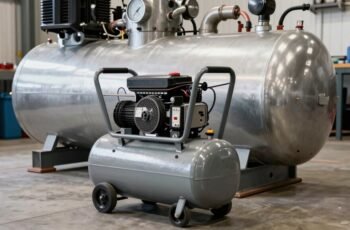
While both high pressure and standard air compressors serve the fundamental purpose of generating compressed air, they differ considerably in design, capacity, and application. High pressure compressors are engineered to deliver air at markedly higher pressures, often exceeding 300 psi, making them suitable for specialized industrial tasks, such as testing, calibration, or certain manufacturing processes. In contrast, standard compressors typically operate within a pressure range of 100 to 150 psi, optimized for general use like powering pneumatic tools or HVAC systems. The key distinction lies in their components and operational parameters: high pressure units incorporate reinforced seals and robust valves to handle increased stress, whereas standard units prioritize efficiency and portability for everyday applications. This fundamental difference influences their design choices and practical deployment.
How Do They Differ in Design and Operation?
High pressure and standard compressors differ markedly in their design and operational mechanisms to accommodate their respective pressure requirements. High pressure compressors utilize reinforced cylinders, specialized valves, and enhanced sealing systems to withstand elevated internal stresses. They often employ multi-stage compression with intercooling to manage heat and improve efficiency. Conversely, standard compressors feature simpler, single-stage designs optimized for moderate pressure outputs, with materials and components suited for lower stress levels. Operationally, high pressure units require precise control systems to regulate pressure buildup and ensure safety, often incorporating safety valves and pressure sensors. Standard compressors prioritize straightforward operation and cost-effectiveness for typical applications. These fundamental differences reflect their distinct engineering goals: high pressure models focus on durability and precision, while standard models emphasize simplicity and affordability.
What Use Cases Are Best Suited for High Pressure Compressors?
High pressure compressors are ideally suited for applications that demand the compression of gases to substantially elevated pressures, often exceeding standard operational levels. These compressors excel in scenarios requiring precise, high-pressure delivery for specialized tasks.
- Hydrogen fueling stations benefit from high-pressure compression to store and dispense fuel efficiently.
- Industrial gas blending demands high pressures to accurately mix gases at specific ratios.
- Aerospace testing uses high-pressure chambers for simulating extreme conditions.
- High-pressure water jet cutting relies on compressed air at elevated pressures for precision cutting tasks.
In these use cases, the ability to generate and sustain high pressures ensures operational efficiency, safety, and accuracy, making high pressure compressors indispensable in demanding technical environments.
When Should You Choose a Standard Compressor Instead?
We should consider a standard compressor when tasks are small-scale and do not require high pressure, as they generally offer better cost efficiency. Additionally, their lower power demands make them suitable for applications with limited energy resources. In such cases, opting for a standard compressor guarantees ideal performance without unnecessary expenditure.
Cost-Effective For Small Tasks
For small-scale tasks that require minimal airflow and lower power output, opting for a standard compressor often proves to be more cost-effective. These compressors are generally less expensive upfront and have lower maintenance costs, making them ideal for localized or infrequent use.
Consider these factors:
- Initial Investment – Standard compressors usually have a lower purchase price.
- Operational Costs – They consume less energy for small tasks, reducing ongoing expenses.
- Maintenance – Simpler designs lead to easier, less costly repairs.
- Application Scope – Adequate for tasks like tire inflation, small spray jobs, or light tools, where high pressure or volume isn’t necessary.
Choosing a standard compressor in these contexts guarantees economical operation without sacrificing performance for small tasks.
Lower Power Requirements
When determining whether to choose a standard compressor, it’s essential to take into account the power requirements of the task at hand. Standard compressors generally operate at lower power levels, making them suitable for applications with limited energy supply or where energy efficiency is prioritized. If your project involves intermittent use, small-scale operations, or equipment that doesn’t demand high airflow rates, a standard compressor offers a practical advantage due to its reduced electrical load. Additionally, these compressors typically have lower operational costs and simpler maintenance, which can be beneficial for smaller or less intensive tasks. Consequently, when power consumption and operational efficiency are key considerations, opting for a standard compressor is often the most appropriate choice.
Key Factors to Consider When Choosing Between Them
Selecting the appropriate compressor depends on evaluating several critical factors that influence performance, efficiency, and long-term operational costs. Key considerations include:
Choosing the right compressor involves assessing pressure, flow, application needs, and energy efficiency for optimal performance and cost savings.
- Pressure requirements: High-pressure compressors suit applications demanding elevated PSI, whereas standard compressors generally suffice for lower pressure needs.
- Flow rate capacity: Determine the volume of air needed; high-pressure units often have reduced flow rates at elevated pressures compared to standard models.
- Application specificity: Assess whether the operation requires specialized high-pressure outputs or if standard compression meets the task.
- Energy consumption: Consider the energy efficiency relative to operational demands, as high-pressure units may consume more power under certain loads.
Evaluating these factors guarantees suitable selection aligned with technical needs, minimizing inefficiencies and unnecessary costs.
Comparing Costs, Maintenance, and Longevity
While high-pressure air compressors often entail higher initial investments, their long-term costs and maintenance requirements can vary considerably from standard models. Typically, high-pressure units demand specialized components, increasing maintenance complexity and expense. Conversely, their durability may offset frequent maintenance costs, offering longer operational lifespans under proper conditions. To compare, consider the following:
| Aspect | High-Pressure Compressor | Standard Compressor |
|---|---|---|
| Initial Cost | Higher due to specialized parts | Lower, more widely available |
| Maintenance | More complex, requires specialized skills | Simpler, easier to service |
| Longevity | Often longer with proper upkeep | Varies, potentially shorter lifespan |
In essence, high-pressure models may have higher upfront and maintenance costs but can provide extended longevity, making them suitable for demanding applications.
Safety Precautions for High Pressure vs. Standard Compressors
Proper handling procedures and regular safety inspections are essential for both high-pressure and standard compressors to prevent accidents and equipment failure. High-pressure systems demand stricter adherence to safety protocols due to increased risks, while standard compressors still require consistent checks to guarantee safe operation. Analyzing these precautions helps us understand the specific measures necessary for each type’s safe use.
Proper Handling Procedures
Because high-pressure air compressors operate at markedly greater pressures than standard models, they demand stricter safety protocols to prevent accidents and equipment failure. Proper handling procedures are critical for ensuring safe operation and longevity of the equipment.
To mitigate risks, we recommend these key steps:
- Always wear appropriate personal protective equipment (PPE), including eye and ear protection.
- Secure all connections tightly to prevent leaks or accidental disconnections under high pressure.
- Regularly monitor pressure gauges and avoid exceeding recommended pressure limits.
- Conduct immediate shutdown procedures if abnormal vibrations, noises, or temperature fluctuations occur.
Adhering to these procedures minimizes hazards, maintains system integrity, and promotes safe operation in environments with high-pressure compressors.
Regular Safety Inspections
How do we guarantee ongoing safety with high-pressure air compressors compared to standard models? Regular safety inspections are essential for both types, but high-pressure systems demand more rigorous protocols. We systematically check pressure relief valves, gauges, and fittings for wear, corrosion, and proper calibration. In high-pressure compressors, we pay close attention to cylinder integrity and weld joints, as failure risks escalate with pressure levels. For standard models, inspections typically focus on hoses and seals. We also document inspection results meticulously, ensuring timely maintenance and repairs. These inspections help identify potential failure points before they cause accidents. Ultimately, thorough, scheduled safety checks are crucial to mitigate risks, maintain operational integrity, and ensure personnel safety across both compressor types.
Which Compressor Is Right for Your Needs? A Quick Decision Guide
Determining whether a high-pressure air compressor or a standard compressor is right for your application hinges on understanding your specific operational requirements. To make an informed choice, consider these factors:
Choosing the right compressor depends on your specific pressure, flow, and application needs.
- Pressure Needs: Assess whether your application demands pressures above 150 psi or standard levels below that.
- Flow Rate: Determine if your process requires high-volume airflow or lower, consistent volumes.
- Application Type: Identify if your work involves industrial manufacturing, testing, or general tool operation.
- Budget & Maintenance: Evaluate long-term costs, including initial investment, maintenance, and operational expenses.
Frequently Asked Questions
What Are the Environmental Impacts of High Pressure Versus Standard Compressors?
We find high-pressure compressors generally consume more energy and produce higher noise levels, impacting the environment more than standard compressors, which are more energy-efficient and quieter, though both contribute to greenhouse gas emissions depending on energy sources used.
How Do Energy Efficiencies Compare Between High Pressure and Standard Compressors?
We find high pressure compressors are approximately 15-20% more energy-efficient than standard ones, meaning they convert more input energy into useful output, reducing waste and operational costs, which is essential for optimizing industrial productivity and sustainability.
Are There Specific Industry Regulations Affecting High Pressure Compressor Use?
We find that industry regulations often impose strict safety, environmental, and operational standards on high-pressure compressors, requiring rigorous compliance, regular inspections, and adherence to regional codes to guarantee safe, efficient, and environmentally responsible use across applications.
Can Standard Compressors Be Upgraded to Handle Higher Pressures?
Yes, standard compressors can often be upgraded for higher pressures by reinforcing components, upgrading valves, and optimizing cooling systems, but we must evaluate structural limits and safety regulations to guarantee reliable, compliant operation with increased pressure requirements.
What Are the Noise Level Differences Between High Pressure and Standard Compressors?
Imagine a whisper in a bustling factory—high pressure compressors are generally louder than standard ones, due to their increased operating pressures and components. We find their noise levels can be markedly higher, impacting workplace acoustics and safety.
Conclusion
Choosing between a high-pressure and a standard compressor is like selecting the right tool for a precise job. We must weigh their design complexities, safety demands, and operational costs, much like balancing a delicate equation. By understanding your specific needs, you can navigate this technical landscape wisely. With the right choice, you’ll harness the power of compressed air efficiently—transforming a simple tool into a reliable force that drives your projects forward confidently.