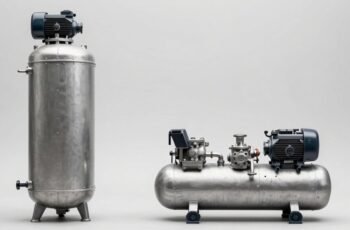
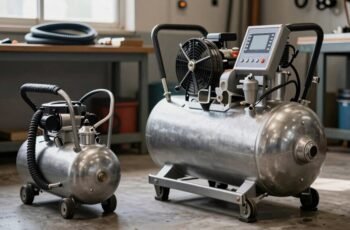
When selecting an air compressor, understanding the fundamental differences between reciprocating and rotary screw models is essential. Each type offers distinct advantages and limitations that directly impact performance, efficiency, and maintenance. To determine the best fit for your application, we need to analyze operational characteristics, cost factors, and long-term suitability. Exploring these aspects in detail reveals critical insights that might influence your decision—insights we’ll uncover as we compare these two technologies side by side.
Key Takeaways
- Rotary screw compressors provide continuous, smooth airflow and are more energy-efficient for steady, high-volume applications.
- Reciprocating compressors are more suitable for intermittent use, offering lower initial costs but higher maintenance.
- Rotary screw units operate more quietly, have longer service life, and require less frequent maintenance than reciprocating models.
- Reciprocating compressors are typically more compact and cost-effective upfront, ideal for portable or small-scale needs.
- Long-term, rotary screw compressors save energy and reduce operational costs, making them better for industrial, continuous operations.
What Are Reciprocating and Rotary Screw Compressors?
Reciprocating and rotary screw compressors are the two primary types of positive displacement air compressors, each employing distinct mechanisms to compress air. Reciprocating compressors operate through a piston within a cylinder, where the piston moves back and forth to intake and compress air during the cycle. This design allows for high-pressure output but often results in higher vibration and noise levels. In contrast, rotary screw compressors utilize two intermeshing helical screws that continuously rotate to trap and compress air. This mechanism provides a steady, smooth flow of compressed air with less vibration and noise. Both types are essential in various industrial applications, but their differing operational principles influence their efficiency, maintenance needs, and suitability for specific use cases.
How Do Reciprocating and Rotary Screw Compressors Work?
Reciprocating and rotary screw compressors employ different compression mechanisms—piston-based versus screw-based—that influence their operational processes. While reciprocating compressors use pistons to compress air in discrete strokes, rotary screw units rely on meshing helical rotors for continuous compression. Understanding these fundamental differences clarifies how each design impacts performance and application suitability.
Compression Mechanism Differences
Understanding how these compressors operate requires examining their core compression mechanisms. Reciprocating compressors use a piston within a cylinder that moves linearly, compressing air through a series of intake and exhaust strokes. This mechanism relies on valves to control airflow, resulting in a cyclical compression process characterized by pressure fluctuations and pulsations. In contrast, rotary screw compressors employ two meshing helical screws that rotate within a casing. As the screws turn, they trap and compress air in the intermeshing cavities, providing continuous, steady airflow. The key distinction lies in the compression approach: reciprocating units generate high-pressure pulses due to their piston action, whereas rotary screw units deliver a more uniform, constant flow. These fundamental differences influence efficiency, maintenance, and suitability for various industrial applications.
Operational Process Variations
The operational processes of reciprocating and rotary screw compressors differ markedly in how they generate compressed air, driven by their distinct mechanical motions. Reciprocating compressors utilize pistons moving within cylinders, creating a series of discrete compression cycles. In contrast, rotary screw compressors employ two intermeshing helical rotors that continuously trap and push air forward.
Key process differences include:
- Compression type: Reciprocating offers discrete, step-wise compression; rotary screw provides continuous compression.
- Operational flow: Reciprocating units cycle on and off, while screw compressors run steadily.
- Efficiency: Rotary screw compressors generally operate more efficiently at steady loads.
- Maintenance: Reciprocating compressors involve more frequent, intensive maintenance due to piston wear.
Comparing Performance: Efficiency, Capacity, and Durability
When comparing reciprocating and rotary screw compressors, energy consumption and potential savings are key considerations, as efficiency directly impacts operational costs. We also examine longevity and maintenance demands, which influence long-term durability and total cost of ownership. Understanding these performance aspects helps identify which compressor best aligns with specific industrial requirements.
Energy Consumption and Savings
Comparing the energy consumption of reciprocating and rotary screw air compressors reveals significant differences in efficiency, capacity, and durability. Rotary screw compressors generally offer higher energy efficiency, especially at continuous operation, due to their continuous, rotary motion reducing energy losses. Conversely, reciprocating units tend to consume more energy per unit of air delivered, particularly under variable loads. To analyze their performance:
- Rotary screw compressors can achieve 5-10% energy savings compared to reciprocating models.
- They maintain stable power consumption across varying demands, improving overall efficiency.
- Reciprocating compressors often require more energy during startup and pressure fluctuations.
- Over time, rotary screw units tend to deliver lower operational costs due to reduced energy waste.
This comparison highlights the importance of selecting equipment aligned with operational demands to optimize energy savings.
Longevity and Maintenance Needs
Although both reciprocating and rotary screw compressors are designed for durability, their longevity and maintenance needs differ markedly due to operational mechanisms. Reciprocating compressors, with their piston-based systems, experience higher wear on valves, piston rings, and cylinders, leading to increased maintenance intervals and costs. They are more prone to vibration and thermal stress, which can accelerate component degradation. In contrast, rotary screw compressors feature continuous meshing rotors in a sealed chamber, resulting in smoother operation and less wear over time. They typically require less frequent maintenance, primarily involving oil changes, filter replacements, and seal inspections. Overall, rotary screw units tend to offer longer service life and lower maintenance demands, making them more suitable for continuous, high-demand applications.
Which Compressor Is Better for Small-Scale or Portable Use?
Which type of compressor suits small-scale or portable applications best? Rotary screw compressors are generally more suitable due to their continuous operation and higher efficiency, but reciprocating units offer advantages in portability and simplicity. When evaluating options, consider:
Reciprocating compressors excel in portability, simplicity, and affordability for small-scale applications.
- Size and Weight: Reciprocating compressors are typically lighter and more compact, making them ideal for mobility.
- Power Requirements: Small reciprocating units often operate on lower power, suitable for limited power sources.
- Operational Noise: Reciprocating models tend to be quieter at lower capacities, beneficial for sensitive environments.
- Cost and Maintenance: Reciprocating compressors are usually less expensive upfront and easier to maintain in portable setups.
Which Compressor Is Suitable for Continuous, Heavy-Duty Operations?
For continuous, heavy-duty operations, rotary screw compressors are generally more suitable due to their ability to deliver consistent airflow and maintain high efficiency under prolonged use. Their robust design guarantees stable performance, minimizing pressure fluctuations that can disrupt industrial processes. Unlike reciprocating compressors, which cycle on and off and are prone to thermal and mechanical stress during extended operation, rotary screw units operate continuously with minimal downtime. Their rotary mechanism provides uniform compression, reducing wear and extending service life in demanding environments. Additionally, rotary screw compressors offer better energy efficiency at high capacities, which is critical for sustained operation. This reliability and efficiency make them the preferred choice for industries requiring nonstop, high-volume air supply.
Cost Considerations: Initial Investment and Maintenance Expenses
When evaluating compressor options, understanding the cost implications of initial investment and ongoing maintenance is essential. Reciprocating compressors generally have a lower upfront cost but higher maintenance expenses, due to more wear parts and frequent servicing. Rotary screw compressors require a higher initial investment but typically offer lower maintenance costs over time, thanks to fewer moving parts and more durable components.
Key considerations include:
- Purchase price and installation costs
- Routine maintenance and component replacement
- Energy consumption and efficiency
- Long-term operational expenses
A thorough cost analysis reveals that while reciprocating units may be more economical initially, rotary screws can provide cost savings through reduced downtime and maintenance. An informed decision hinges on balancing initial outlay with ongoing operational costs.
Making the Right Choice: Key Factors to Consider for Your Application
Determining the most suitable compressor type requires a careful assessment of your specific operational demands and application parameters. Factors such as required airflow volume, pressure levels, duty cycle, and operational environment are critical. For high-demand, continuous operations with consistent airflow, rotary screw compressors offer efficiency and reliability. Conversely, reciprocating compressors excel in applications with intermittent or lower-volume requirements, where precise pressure control is essential. Energy consumption and maintenance frequency should also influence your decision, as rotary screws typically have lower operational costs over time. Additionally, space constraints and noise considerations may sway your choice, with reciprocating units often being more compact but noisier. Ultimately, a thorough analysis of your application’s load profile, budget, and long-term operational goals guides an informed, strategic decision.
Frequently Asked Questions
How Long Do Reciprocating and Rotary Screw Compressors Typically Last?
Reciprocating compressors typically last 10-15 years with proper maintenance, while rotary screw compressors can last 15-20 years. Regular servicing, operating conditions, and quality components considerably influence their lifespan, ensuring ideal performance over time.
What Are the Environmental Impacts of Each Compressor Type?
They say every coin has two sides. Both compressor types impact the environment by consuming energy and producing emissions, but rotary screw compressors often operate more efficiently, reducing their ecological footprint compared to reciprocating models.
Are There Any Noise Level Differences Between Reciprocating and Rotary Screw Models?
We find that rotary screw compressors generally operate more quietly than reciprocating models due to their continuous, smooth operation, reducing noise levels substantially. This makes rotary screws preferable for noise-sensitive environments, offering improved acoustic performance.
Which Compressor Type Requires Less Downtime for Maintenance?
We find rotary screw compressors require less downtime for maintenance, acting like a reliable engine purring smoothly, thanks to their continuous operation and fewer moving parts, making them ideal for high-demand, consistent industrial applications.
Can Both Compressor Types Handle Variable Load Conditions Effectively?
Both compressor types handle variable load conditions effectively; reciprocating compressors excel with short-term, high-pressure demands, while rotary screw models maintain efficiency during continuous, moderate loads, making them adaptable based on specific operational requirements and load variability.
Conclusion
Ultimately, selecting between reciprocating and rotary screw compressors hinges on understanding your specific needs. While reciprocating units excel in portability and intermittent use, rotary screws shine in continuous, high-demand applications. By weighing efficiency, maintenance, and initial costs, we can align our choice with operational demands. It’s essential to recognize that rushing into a decision may lead us astray—sometimes, the best course is to look before we leap, ensuring our investment pays dividends in the long run.