Mini air compressors and portable compressors serve distinct purposes, offering different levels of power, size, and convenience. They are designed to meet specific needs, from quick inflation tasks to demanding pneumatic jobs. Understanding their technical differences and use cases can markedly impact your choice, especially when considering efficiency, performance, and application scope. As we compare these options, we uncover the nuances that help determine the best fit for your requirements.
Key Takeaways
- Mini air compressors are smaller, lightweight, and ideal for quick, low-demand tasks; portable compressors are larger with higher power for more demanding applications.
- Mini compressors typically have smaller tanks and lower airflow (1-2 CFM), limiting continuous use, unlike portable units with bigger tanks and higher CFM.
- Mini compressors excel in confined spaces and portability, while portable compressors are suited for mobile, higher-volume, and industrial tasks.
- Mini units often have lower noise levels and are easier to carry, whereas portable compressors may be bulkier and noisier.
- Choose a mini compressor for quick, light jobs; opt for a portable compressor for versatile, higher-capacity, and more durable performance.
What Are Mini Air Compressors and How Do They Work?
What exactly are mini air compressors, and how do they operate within their compact design? These devices are small-scale pneumatic tools that generate compressed air through a miniature motor and piston or rotary mechanism. Despite their size, they employ efficient compression cycles, often using lightweight materials to optimize airflow and pressure output. They typically feature integrated tanks or direct-air outlets, enabling quick, on-demand air supply for tasks like inflating tires or powering small tools. Their design minimizes components to reduce weight and enhance portability, but this also limits their capacity and continuous operation. Internally, they rely on precise control of intake valves, compression chambers, and exhaust systems to maintain consistent pressure levels, making them technically sophisticated despite their diminutive form factor.
Key Differences in Size, Power, and Portability
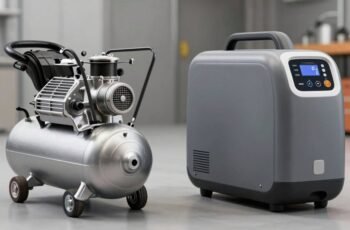
Mini air compressors are particularly smaller and lighter than portable compressors, primarily designed for convenience and ease of transport rather than sustained, high-capacity use. They typically feature lower power output, limiting their ability to handle demanding tasks. Portable compressors, however, are generally larger, with increased power and capacity, making them suitable for more intensive applications.
| Feature | Mini Air Compressor | Portable Compressor |
|---|---|---|
| Size | Compact, lightweight | Larger, bulkier |
| Power Output | Lower (1-2 CFM) | Higher (3-6 CFM) |
| Portability | Easy to carry | Requires transport aid |
| Ideal Use | Quick, small tasks | Heavy-duty jobs |
| Energy Consumption | Lower | Higher |
This comparison highlights the trade-offs between size, power, and portability, guiding users toward the appropriate tool for their needs.
Best Use Cases for Mini Air Compressors
Have you considered how compact tools can optimize specific tasks that demand portability and quick operation? Mini air compressors excel in applications requiring immediate, on-the-spot inflation or pneumatic assistance. Their lightweight design allows for effortless maneuvering in confined spaces, making them ideal for roadside tire repairs, bicycle maintenance, or inflating sports equipment. In industrial settings, they support small-scale tasks such as powering pneumatic tools with low air consumption or cleaning delicate components where precision is critical. Additionally, their portability makes them suitable for remote job sites, emergency repairs, or quick maintenance checks. The efficiency of a mini compressor in these scenarios hinges on its ability to deliver sufficient airflow rapidly without the bulk of larger units, making it indispensable for targeted, high-frequency use cases.
Advantages of Choosing a Mini Air Compressor
Mini air compressors are distinguished by their compact and lightweight design, which enhances their usability in confined or mobile environments. Their ease of portability and straightforward storage make them ideal for on-the-go applications and space-constrained settings. These attributes translate into increased efficiency and flexibility for users needing reliable pressurized air in various contexts.
Compact and Lightweight Design
Why does a compact and lightweight design matter when selecting an air compressor? Such design attributes directly influence operational efficiency and usability, especially in constrained environments. A mini air compressor’s reduced size minimizes spatial footprint, enabling installation in tight spaces without compromising performance. The lightweight nature reduces physical strain during transportation, lowering the risk of injury and simplifying handling. From an engineering perspective, this design often involves optimized component integration and material selection, which enhances portability without sacrificing durability. These factors contribute to a device that is not only easier to maneuver but also more adaptable across varied applications—ranging from automotive repairs to small-scale industrial tasks. Ultimately, the compact, lightweight profile enhances operational flexibility and ergonomic efficiency, making it a strategic choice for users seeking both portability and performance.
Easy Portability and Storage
Because of their compact design, mini air compressors excel in ease of portability and storage, making them ideal for users who require quick deployment across multiple sites or confined spaces. Their small footprint allows for effortless transportation in toolboxes, vehicle trunks, or storage closets, reducing logistical complexity. This design minimizes setup time, enabling rapid readiness in dynamic work environments. Additionally, their lightweight nature means they can be carried manually without specialized equipment, enhancing operational flexibility. When not in use, they occupy minimal space, simplifying storage in workshops, garages, or on job sites. This combination of portability and efficient storage not only saves time but also ensures that the compressor can be readily available whenever needed, optimizing productivity and minimizing downtime in various applications.
Limitations and When to Avoid Mini Compressors
While mini air compressors are valued for their portability and convenience, they have significant limitations that can hinder their effectiveness in demanding applications. Their small motor size and tank capacity restrict airflow and pressure output, making them unsuitable for continuous, high-volume tasks. Additionally, their limited power can cause overheating during extended use, reducing reliability and lifespan. Noise levels, although generally lower, can still be problematic in quiet environments. We advise avoiding mini compressors when working on large-scale projects, such as automotive repairs or industrial tasks, where sustained pressure and airflow are critical. They are also ill-suited for applications requiring precise or high-pressure outputs. Recognizing these limitations helps guarantee we select the appropriate tool for the task, avoiding inefficiency and potential equipment damage.
What Are Portable Air Compressors and How Do They Differ?
What exactly distinguishes portable air compressors from their mini counterparts? Portable compressors are designed with a focus on mobility and higher capacity, often featuring larger tanks and more robust power sources. They typically operate via electric motors or gas engines, enabling them to handle a broader range of tasks and longer operation times. Their structural design emphasizes durability, stability, and ease of transport, often including wheels and ergonomic handles. Unlike mini compressors, which prioritize compactness and portability for light-duty applications, portable units are engineered for versatile, sustained use in diverse environments. They offer increased airflow rates and pressure levels, making them suitable for tasks like tire inflation, pneumatic tools, and construction work. This technical distinction underscores their role in more demanding and professional settings.
Top Benefits of Opting for a Portable Compressor
Opting for a portable compressor offers significant advantages in versatility and efficiency, particularly for users who require reliable performance across varied work environments. Its design enables easy transportation, reducing setup time and increasing operational flexibility. Portable compressors typically feature lightweight construction and integrated handles, facilitating quick deployment in remote or confined spaces. They also support multiple applications, from inflating tires to powering pneumatic tools, making them a multi-functional asset. Technically, these units often incorporate high-efficiency motors and optimized airflow pathways, ensuring consistent pressure output with minimal energy consumption. This combination of mobility, adaptability, and technical performance enhances productivity by allowing users to maintain continuous workflows without dependency on fixed installations. Consequently, portable compressors are integral for dynamic, on-the-go operations demanding reliable, on-demand compressed air.
Common Drawbacks of Portable Compressors
Despite their portability and convenience, portable compressors often face limitations related to power output and operational endurance. Their compact design restricts motor size, leading to lower CFM (cubic feet per minute) ratings, which limits their ability to handle high-demand tasks efficiently. Additionally, their smaller tanks require frequent rest periods to prevent overheating and maintain safe operation, reducing continuous runtime. Over time, these constraints can result in inconsistent performance, especially during prolonged use. The lightweight construction, while beneficial for mobility, can also compromise durability, making them more susceptible to damage under heavy or industrial workloads. Consequently, users may find portable compressors less suitable for demanding applications requiring sustained pressure and high airflow, necessitating careful consideration of their operational scope.
How to Decide Between a Mini Air Compressor and a Portable Compressor
When choosing between a mini air compressor and a portable compressor, it’s essential to carefully evaluate the specific requirements of your tasks and operational environment. Consider the volume and pressure demands of your applications—mini compressors excel at low-volume, high-pressure tasks, while portable units handle higher airflow needs. Assess portability requirements: if mobility is critical, a lightweight, compact model is preferable. Evaluate power sources and runtime constraints—mini compressors often operate on lower power, making them suitable for intermittent use. Additionally, analyze noise levels and durability in your work setting. By aligning compressor specifications with your operational needs—such as task complexity, frequency, and environment—you can make an informed decision that optimizes efficiency and performance.
Frequently Asked Questions
How Long Can a Mini Air Compressor Operate Continuously?
A mini air compressor typically operates continuously for about 10 to 30 minutes, depending on its design, duty cycle, and cooling capacity. We recommend monitoring its temperature and performance to prevent overheating and guarantee ideal function during extended use.
What Maintenance Is Required for Portable Air Compressors?
We recommend regularly checking and replacing the oil, inspecting filters, draining moisture from tanks, and tightening fittings to guarantee peak performance and longevity of portable air compressors, preventing wear and maintaining efficiency over time.
Are Mini Air Compressors Suitable for Industrial Use?
Mini air compressors are generally unsuitable for industrial use due to limited capacity, durability, and airflow. We find them ideal for small tasks, but for heavy-duty applications, larger, more robust compressors are necessary to meet industrial demands efficiently.
How Noisy Are Portable Air Compressors During Operation?
Portable air compressors typically generate noise levels between 70 to 90 decibels, which can be quite loud. We analyze their noise output to help you choose models suitable for your environment, considering noise-sensitive areas.
Can Mini Air Compressors Handle High-Pressure Tasks?
Mini air compressors can handle high-pressure tasks surprisingly well, often exceeding expectations, but their capacity is limited compared to larger models. We recommend evaluating specific pressure ratings and duty cycles to guarantee suitability for demanding applications.
Conclusion
In summary, choosing between a mini and portable compressor hinges on your specific needs, but consider this: a mini compressor is like the nimble scalpel of air tools—perfect for quick, precise tasks—while a portable compressor is the heavyweight champion, capable of tackling the most demanding jobs with relentless power. Your decision ultimately shapes your efficiency, precision, and productivity—making it a strategic investment that can either elevate your tasks to art or limit your potential like a broken tool in the hands of a craftsman.