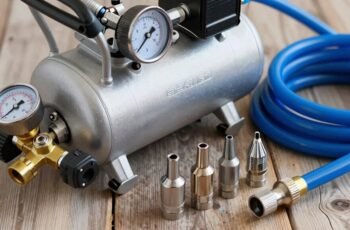
It’s a coincidence that many people overlook the critical details when selecting a gas-powered air compressor, yet making the right choice can considerably impact your work efficiency and equipment longevity. Understanding the technical aspects—such as size, power, and durability features—requires careful consideration, especially as these factors directly influence performance and safety. To make certain you make an informed decision that aligns with your specific needs, it’s crucial to explore the key elements that define a quality gas compressor and how they apply to your applications.
Key Takeaways
- Match compressor CFM and PSI ratings to your tools’ airflow and pressure requirements for optimal performance.
- Decide between portable or stationary models based on mobility needs and workload size.
- Prioritize durable construction features like cast iron cylinders and corrosion-resistant components for longevity.
- Consider engine horsepower, tank capacity, and build quality to ensure the compressor meets current and future demands.
- Follow safety guidelines and choose reputable brands for reliable operation and easier maintenance.
What Are Gas-Powered Air Compressors and How Do They Work?
Have you ever wondered how gas-powered air compressors generate the compressed air needed for various tools and applications? These machines operate using an internal combustion engine, typically fueled by gasoline or diesel, which drives a piston or rotary screw mechanism. As the engine runs, it powers a cylinder where a piston moves back and forth, drawing in atmospheric air through an intake valve. This air is compressed as the piston moves inward, reducing its volume and increasing its pressure. The compressed air is then stored in a tank or delivered directly to tools via a regulated outlet. The key to their functionality lies in the precise control of intake and exhaust valves, allowing continuous compression cycles, making gas-powered compressors suitable for portable, high-demand environments.
Key Features to Consider When Choosing a Gas-Powered Air Compressor
Selecting the right gas-powered air compressor requires careful evaluation of several key features that directly impact performance, portability, and durability. We focus on motor horsepower, CFM (cubic feet per minute), PSI (pounds per square inch), tank capacity, and build quality. High horsepower engines deliver more power, suitable for demanding tasks. CFM indicates airflow volume, essential for continuous operation. PSI reflects pressure output, critical for specific tools. Tank capacity determines runtime before refueling. Build quality influences longevity and resistance to environmental factors.
| Feature | Importance |
|---|---|
| Motor Horsepower | Power and ability to handle heavy-duty applications |
| CFM | Airflow volume, affects tool performance |
| PSI | Operating pressure, impacts tool efficiency |
| Tank Capacity | Runtime before needing to refuel or drain |
| Build Quality | Durability and resistance to wear and tear |
How to Determine the Right Size and Power for Your Needs
To determine the right size and power for your gas-powered air compressor, we need to analyze the specific demands of your intended applications, including the types of tools you’ll operate and the frequency of use. First, identify the air consumption (measured in CFM) required by your tools at their maximum operating pressure, as this guarantees the compressor can sustain continuous operation without overload. Next, consider the compressor’s PSI rating, ensuring it matches or exceeds your tools’ requirements. Power output, typically expressed in horsepower (HP), should be sufficient to meet the CFM needs with minimal strain, accounting for duty cycle and potential future expansion. Accurate assessment of these parameters guarantees ideal performance, efficiency, and longevity of your compressor tailored to your workload.
Portable vs. Stationary Gas Air Compressors: Which Is Better?
When choosing between portable and stationary gas-powered air compressors, we must consider factors like mobility, which affects ease of transport and flexibility, versus power and performance levels necessary for demanding tasks. Space and installation requirements also play a critical role, as stationary units typically need dedicated areas, while portable models prioritize compactness for on-the-go use. Analyzing these points helps determine which type aligns best with specific operational needs and workspace constraints.
Portability and Mobility
Have you ever considered how the mobility of an air compressor impacts its usability on job sites? Portable units excel in environments requiring frequent relocation, featuring integrated handles, wheels, or compact frames for easy transport. They enable quick setup in tight spaces, making them ideal for construction sites, roadside repairs, or remote locations. Conversely, stationary compressors are designed for fixed installation, often mounted on concrete pads or frames, providing stability and reduced vibration during continuous operation. Their larger size supports higher capacity and longer run times but limits movement. Visualize a portable compressor with:
- Rugged wheels for uneven terrain
- Compact design for storage
- Handles for one-person maneuvering
Understanding these differences helps determine which type aligns with your project’s mobility needs, ensuring efficiency and operational flexibility.
Power and Performance
While portable and stationary gas air compressors differ markedly in design, their power output and performance capabilities are often the primary factors influencing suitability for specific applications. Portable units typically feature smaller engines, usually between 5 to 15 horsepower, delivering lower CFM (cubic feet per minute) and PSI (pounds per square inch), suitable for light to moderate tasks. In contrast, stationary compressors boast larger engines—up to 50 horsepower or more—providing higher CFM and PSI ratings, making them ideal for continuous, heavy-duty operations. Performance consistency also varies; stationary models generally offer more stable pressure and longer operational periods due to enhanced cooling and fuel systems. Ultimately, selecting between them hinges on the required airflow, duty cycle, and operational intensity of the intended application.
Space and Installation
Choosing between portable and stationary gas air compressors often hinges on available space and installation constraints. Portable models are compact, easily transported, and require minimal setup—ideal for dynamic work environments. They can be moved to different job sites or locations within a facility with ease. In contrast, stationary compressors demand dedicated space, often requiring a stable foundation, proper ventilation, and secure mounting. They are suited for continuous, high-demand applications where stability and noise reduction are priorities. Visualize a portable unit nestled in a truck bed, ready to deploy, versus a large, fixed compressor mounted in a dedicated corner of a workshop, with dedicated electrical or fuel connections. The choice depends on whether mobility or stability aligns better with your operational needs.
Understanding Maintenance and Durability for Long-Term Use
To guarantee long-term reliability, we focus on regular maintenance practices like checking oil levels, inspecting hoses, and replacing filters according to the manufacturer’s schedule. The material quality and build of the compressor—such as cast iron cylinders and stainless steel components—significantly influence durability and resistance to wear. Understanding these factors helps optimize performance and extend the lifespan of your compressor investment.
Regular Maintenance Practices
Regular maintenance is essential for guaranteeing the longevity and reliable performance of your air compressor. Proper upkeep minimizes wear, prevents failures, and maintains ideal efficiency. Regularly inspect and clean the cooling fins to prevent overheating, as accumulated debris can impair heat dissipation. Change the oil at manufacturer-recommended intervals to ensure proper lubrication and reduce internal friction, extending component life. Check and replace air filters to prevent contaminants from entering the system, which can cause damage to valves and pistons. Additionally, monitor and tighten all fittings and hoses to prevent leaks that compromise pressure and efficiency. Keeping a detailed maintenance schedule and adhering to it ensures that each component functions as intended, reducing downtime and costly repairs over the compressor’s lifespan.
Material Quality and Build
The durability and longevity of an air compressor largely depend on the quality of materials used in its construction and the overall build integrity. High-grade components like cast iron cylinders, stainless steel valves, and corrosion-resistant tanks ensure resilience under continuous operation. A robust frame reduces vibrations and minimizes wear, extending service life. Key construction details, such as reinforced welds and precision-machined parts, prevent leaks and maintain peak efficiency. Consider this comparison:
| Material/Build Feature | Impact on Durability |
|---|---|
| Cast Iron Cylinders | Superior heat dissipation; resistant to wear |
| Stainless Steel Valves | Corrosion-resistant; durable under pressure |
| Steel Frame | Absorbs vibrations; enhances stability |
| Powder-Coated Finish | Prevents rust and corrosion |
| Reinforced Welds | Ensures structural integrity under stress |
Prioritizing these factors guarantees long-term performance and reduces maintenance costs.
Safety Tips for Operating Gas-Powered Air Compressors
Operating gas-powered air compressors safely requires strict adherence to established procedures to prevent accidents and equipment damage. Proper safety practices include ensuring the compressor is on a stable, level surface to avoid tipping, maintaining adequate ventilation to prevent carbon monoxide buildup, and wearing appropriate personal protective equipment such as safety goggles, ear protection, and gloves. Before starting, inspect hoses, fittings, and safety relief valves for leaks or damage. During operation, monitor pressure gauges closely to prevent over-pressurization, which can cause component failure. Always shut down and cool the compressor before performing maintenance or refueling. Remember, a thorough understanding of the compressor’s manual and safety features is essential to operate it effectively and safely.
Comparing Popular Gas Air Compressor Brands and Models
When selecting a gas-powered air compressor, understanding the differences among leading brands and models is essential for making an informed investment. Brand reputation, engine power, and durability vary considerably. For example, Honda models prioritize fuel efficiency and quiet operation, while Ingersoll Rand compressors excel in high airflow output and robustness. To compare effectively, consider technical specifications such as CFM (cubic feet per minute), PSI (pounds per square inch), and tank capacity. Here’s a detailed comparison:
| Brand | Power (hp) | Max CFM | Tank Capacity (gal) |
|---|---|---|---|
| Honda | 5.5 | 9 | 20 |
| Ingersoll Rand | 6.0 | 15 | 30 |
| Makita | 4.5 | 8 | 12 |
| Champion | 6.5 | 14 | 25 |
| DeWalt | 4.0 | 7 | 10 |
This comparison highlights critical performance metrics essential for selecting the right model.
Tips for Buying a Gas Air Compressor Within Your Budget
Balancing quality and cost is essential when purchasing a gas-powered air compressor, especially if you’re working within a fixed budget. To optimize your investment, prioritize models with an appropriate CFM (cubic feet per minute) rating for your tasks, guaranteeing sufficient airflow without excess. Focus on compressors with durable cast iron cylinders and high-quality valves, which improve longevity and efficiency—costing less over time. Also, consider the compressor’s fuel efficiency and maintenance requirements to avoid hidden expenses. Visualize a compressor with:
- A sturdy, corrosion-resistant steel frame
- An efficient cooling system preventing overheating
- An easily accessible oil and filter system for quick upkeep
These features guarantee reliable performance within your financial limits while maintaining technical robustness.
Common Troubleshooting Tips for Gas-Powered Air Compressors
Gas-powered air compressors can encounter various issues that disrupt their performance, but many of these problems can be diagnosed and resolved with systematic troubleshooting. First, check the fuel system—inspect for stale fuel, clogged filters, or leaks that may impede combustion. Make certain the oil levels are adequate, as low oil can trigger safety shutoffs or cause overheating. For pressure inconsistencies, verify that the pressure relief valve isn’t stuck open and that the unloader valve operates correctly. If the compressor fails to start, examine the spark plug for fouling or damage, and confirm the ignition system functions properly. Additionally, listen for abnormal noises, which often indicate worn bearings or loose components. Regular maintenance and targeted inspections help identify issues early, ensuring reliable operation and extending the compressor’s lifespan.
Frequently Asked Questions
What Are the Environmental Impacts of Using Gas-Powered Air Compressors?
Gas-powered air compressors emit greenhouse gases like carbon dioxide and nitrogen oxides, contributing to climate change and air pollution. They also produce noise pollution and risk fuel spills, impacting ecosystems and human health.
How Fuel-Efficient Are Different Gas Compressor Models?
We find that fuel efficiency varies considerably among models; well-designed engines with advanced combustion technology offer up to 25% better mileage, reducing operational costs and environmental impact, even amidst concerns about fuel consumption and emissions.
Can Gas-Powered Air Compressors Be Used Indoors Safely?
Gas-powered air compressors are generally unsafe for indoor use due to carbon monoxide emission and inadequate ventilation. We recommend using electric models indoors and reserving gas-powered compressors for outdoor applications with proper ventilation.
Are There Eco-Friendly Alternatives to Gas-Powered Compressors?
Yes, we recommend electric compressors with energy-efficient motors and environmentally friendly refrigerants, as they produce fewer emissions, operate quieter, and reduce carbon footprints, making them superior eco-friendly alternatives to gas-powered compressors for most applications.
What Are the Noise Level Differences Among Various Models?
We find that noise levels vary markedly among models, with diesel compressors often producing 80-100 dB, while newer gasoline models feature mufflers reducing noise to around 70-85 dB, making them more suitable for noise-sensitive environments.
Conclusion
As we navigate the intricate circuitry of choosing the perfect gas-powered air compressor, it’s clear that understanding each component and feature is like decoding a complex machine—each part working in harmony. With careful consideration of size, power, durability, and safety, we can guarantee our investment runs smoothly like a finely tuned engine. In the end, selecting the right compressor is about forging a reliable, resilient tool that powers our projects with precision and confidence.