When a manufacturing plant upgrades from handheld tools to a stationary air compressor, choosing the right model becomes critical to maintaining productivity. We recognize that selecting a compressor involves analyzing technical specifications like power, capacity, and pressure ratings, which directly impact operational efficiency and long-term costs. With so many options available, understanding key factors can prevent costly mistakes and ensure reliable performance—making it essential to approach your purchase with a thorough, data-driven perspective.
Key Takeaways
- Assess your operational airflow needs (CFM) and pressure requirements (PSI) to select appropriately rated equipment.
- Consider space, installation, and maintenance access to ensure efficient setup and long-term reliability.
- Choose features like oil lubrication, variable speed drives, and filtration to enhance efficiency and lifespan.
- Balance initial cost with total ownership expenses, including energy, maintenance, and durability.
- Evaluate scalability and ease of maintenance to ensure the compressor supports future growth and operational ease.
What Is a Stationary Air Compressor and How Does It Work?
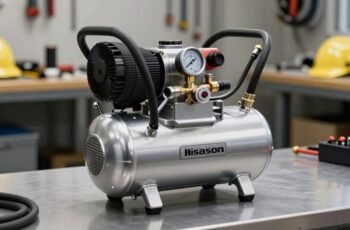
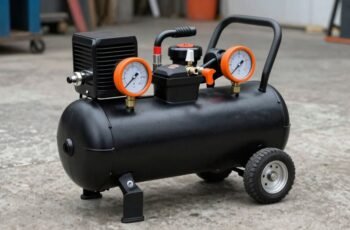
What exactly is a stationary air compressor, and how does it operate within industrial or workshop settings? A stationary air compressor is a fixed device that converts power, typically from an electric motor or engine, into compressed air for various applications. It functions by drawing in ambient air through an intake valve, then compressing it using a piston, rotary screw, or scroll mechanism. The compression process increases air pressure, which is stored in a receiver tank for immediate or future use. This setup guarantees a consistent supply of high-pressure air essential for powering pneumatic tools, machinery, or cleaning systems. Its design emphasizes durability and high-capacity output, making it indispensable in environments requiring reliable, continuous compressed air supply.
Key Factors to Consider When Choosing a Stationary Air Compressor
When selecting a stationary air compressor, we focus on power and capacity to guarantee it meets operational demands, while also considering size and space constraints for ideal installation. Maintenance requirements are equally critical, as they impact long-term reliability and operational costs. By analyzing these factors systematically, we can identify equipment that balances performance, space efficiency, and ease of upkeep.
Power and Capacity
How do we determine the right power and capacity for a stationary air compressor? We analyze operational demands and airflow requirements to select a unit that balances performance and efficiency. Power, measured in horsepower (HP), influences the compressor’s ability to sustain continuous operation under load. Capacity, in CFM (cubic feet per minute), indicates airflow delivery, directly impacting productivity. Here’s a comparison:
| Power (HP) | Typical Application | Capacity (CFM) | Usage Scenario |
|---|---|---|---|
| 5-15 HP | Light manufacturing | 10-25 CFM | Small workshops |
| 20-50 HP | Heavy industrial | 30-100 CFM | Large-scale operations |
Choosing suitably ensures reliable performance, minimizes downtime, and aligns with operational goals.
Size and Space Needs
Selecting the appropriate size and guaranteeing adequate space for a stationary air compressor are critical steps in the purchasing process, as these factors directly affect installation feasibility, operational efficiency, and future scalability. Proper sizing involves evaluating airflow demands and selecting a unit that can handle peak loads without excessive cycling or downtime. Space considerations must account for physical dimensions, ventilation requirements, and access for maintenance. Overestimating space can lead to inefficient layout and increased costs, while underestimating can hinder airflow and cooling, risking equipment longevity. We must evaluate available footprint and clearance requirements to optimize operational flow and safety. Ultimately, aligning compressor size with spatial constraints ensures reliable performance, simplifies installation, and accommodates future capacity expansions.
Maintenance Requirements
Evaluating maintenance requirements is vital to guarantee the long-term reliability and efficiency of a stationary air compressor. Regular upkeep minimizes downtime and prolongs equipment lifespan. Key considerations include filter replacement frequency, lubrication needs, and ease of access for servicing. Some models demand daily checks, while others require less frequent attention, impacting operational planning. Below is a comparison of common maintenance factors:
| Maintenance Aspect | Considerations |
|---|---|
| Filter Replacement | Frequency varies; essential for air quality and efficiency |
| Lubrication | Oil change intervals; synthetic vs. mineral oils |
| Accessibility | Ease of access affects maintenance time and safety |
| Monitoring Systems | Automated alerts reduce manual inspections |
| Service Life | Durability influenced by maintenance schedule |
Types of Stationary Air Compressors and Their Ideal Applications
Understanding the different types of stationary air compressors is essential for selecting the right machine for specific applications. Rotary screw compressors excel in continuous, high-volume operations, while reciprocating units are suited for intermittent, lower-volume tasks. Centrifugal compressors offer advantages in large-scale, high-pressure environments requiring efficient, consistent airflow.
Rotary Screw Compressors
Rotary screw compressors are a dominant choice among stationary air compressors due to their high efficiency and continuous operation capabilities. They operate using two meshing helical screws that compress air steadily, making them ideal for applications requiring a constant and reliable air supply. Their design minimizes pulsation and vibration, resulting in smoother airflow and reduced maintenance needs. These compressors excel in environments demanding high volume and energy efficiency, such as manufacturing plants, automotive assembly lines, and large-scale workshops. They typically feature advanced cooling systems and variable speed drives, allowing precise control over output and power consumption. Overall, rotary screw compressors provide consistent performance with lower operational costs, making them suitable for continuous industrial processes where uptime and efficiency are critical.
Reciprocating Compressor Uses
Have you considered how reciprocating compressors serve specific industrial needs through their straightforward, piston-based design? These units excel in applications requiring high-pressure output and precise control. Their reciprocating mechanism allows for variable displacement, making them suitable for tasks like power tool operation, instrumentation, and manufacturing processes where consistent, high-pressure air is essential. Their ability to operate effectively across a wide range of flow rates and pressures makes them versatile for small- to medium-sized operations. However, their design involves more moving parts, leading to higher maintenance demands compared to other types. Reciprocating compressors are particularly effective in environments where duty cycles are intermittent or where peak pressure levels are critical. Their rugged construction guarantees durability in demanding industrial settings, making them a reliable choice for targeted, high-pressure applications.
Centrifugal Compressor Benefits
Are centrifugal compressors the ideal choice for high-volume, continuous airflow applications? Yes, they excel in scenarios requiring large quantities of compressed air with consistent pressure. Their design, utilizing rapidly spinning impellers, enables high flow rates with minimal maintenance and energy consumption. Unlike reciprocating units, centrifugal compressors operate smoothly, reducing vibrations and operational noise. They are highly scalable, making them suitable for industrial processes such as petrochemical refining, power generation, and large manufacturing facilities. Their ability to deliver a steady, high-volume output at a relatively low operating cost makes them advantageous for continuous operation. However, they require significant initial investment and are less flexible for fluctuating demand. Overall, centrifugal compressors are optimized for large-scale, steady-state applications demanding reliable, high-capacity airflow.
How to Determine the Right Size and Capacity for Your Needs
Choosing the appropriate size and capacity for your stationary air compressor requires a precise assessment of your operational demands. We start by analyzing your required airflow, measured in cubic feet per minute (CFM), and the pressure, indicated in PSI, needed for your applications. It is crucial to identify peak demand scenarios to ensure the compressor can maintain consistent performance without frequent cycling or overload. Consider the types of tools and machinery you’ll operate, as their combined CFM and PSI requirements drive the compressor’s specifications. Overestimating capacity can lead to unnecessary costs and energy inefficiency, while underestimating risks system failure and downtime. Conducting a detailed load analysis allows for selecting a compressor that balances operational efficiency with future scalability, ensuring reliable performance tailored to your specific needs.
Understanding Power, Pressure, and CFM Ratings
Understanding power, pressure, and CFM ratings is fundamental to selecting an effective stationary air compressor. Power, typically measured in horsepower (HP), indicates the motor’s capacity to generate airflow, influencing overall performance and runtime. Pressure, expressed in pounds per square inch (PSI), determines the maximum force the compressor can apply; adequate PSI ensures compatibility with intended tools and applications. CFM (cubic feet per minute) quantifies the volume of air delivered at a specified pressure, directly impacting the compressor’s ability to sustain continuous operation of multiple tools. Precise understanding of these ratings allows us to assess whether a compressor can meet workload demands efficiently without over- or under-sizing. Proper balancing of power, pressure, and CFM ensures maximum performance, energy efficiency, and system longevity.
Features That Improve Efficiency and Longevity
Optimizing an air compressor’s efficiency and lifespan hinges on selecting features that reduce wear and improve operational stability over time. Key components like oil-lubricated cylinders minimize friction, decreasing heat buildup and extending component life. Variable speed drives adapt motor output to demand, conserving energy and reducing stress on parts. High-quality air filtration systems prevent contaminants from damaging internal components, maintaining peak performance. Durable, corrosion-resistant materials in critical parts enhance longevity against environmental factors. Additionally, thermal overload protection and pressure relief valves prevent overpressure and overheating, safeguarding the compressor’s integrity. Incorporating these features ensures consistent operation, reduces maintenance needs, and prolongs overall service life, making the compressor a more reliable and cost-effective investment over its operational lifespan.
Budgeting: What’s the Cost Range and How to Get the Best Value?
Budget considerations play a crucial role in selecting the appropriate stationary air compressor, as costs can vary considerably based on capacity, features, and quality. Typically, entry-level models range from $1,000 to $3,000, offering basic functionality suitable for light-duty applications. Mid-range units, priced between $3,000 and $10,000, provide enhanced durability, higher capacity, and additional features like variable speed controls or integrated cooling systems. Premium models exceeding $10,000 often incorporate advanced automation, superior build materials, and increased efficiency, suitable for industrial-scale operations. To maximize value, we recommend analyzing total cost of ownership, including energy consumption, maintenance expenses, and lifespan. Selecting equipment aligned with operational needs ensures maximum performance while balancing upfront investment and long-term operational costs.
Maintenance Tips to Keep Your Stationary Air Compressor Running Smoothly
Proper maintenance is essential to guarantee your stationary air compressor operates at peak efficiency and longevity. Regular inspection of components like belts, filters, and lubricants ensures maximum performance and prevents premature failure. We recommend monitoring oil levels and replacing oil according to manufacturer specifications to reduce wear on internal parts. Cleaning or replacing air filters prevents contamination and maintains airflow efficiency. Drain condensate from tanks frequently to prevent corrosion and moisture buildup, which can compromise system integrity. Tighten electrical connections and check for leaks in hoses and fittings, as these issues can cause pressure drops or unsafe operating conditions. Implementing a routine maintenance schedule based on operational hours and environmental factors minimizes downtime, enhances energy efficiency, and extends the lifespan of the compressor.
Questions to Ask Before Making Your Purchase Decision?
Before purchasing a stationary air compressor, it’s crucial to evaluate key questions that influence long-term performance and cost-effectiveness. These questions help determine the right specifications and guarantee reliable operation. Consider capacity requirements: Will the compressor meet your peak demand? Also, assess power consumption: Is it energy-efficient for your operational costs? Maintenance needs are critical—how accessible are parts and service? Finally, consider the compressor’s scalability: Will it accommodate future expansion?
| Question | Consideration |
|---|---|
| Capacity and airflow | Match compressor output to your application demands |
| Energy efficiency | Minimize operational costs over the unit’s lifespan |
| Maintenance needs | Ensure ease of service and availability of parts |
| Scalability and future-proofing | Compatibility with potential capacity increases |
Frequently Asked Questions
How Energy-Efficient Are Different Stationary Air Compressor Models?
We find that energy efficiency varies considerably among stationary air compressor models; newer, variable-speed units typically consume less power by adjusting output to demand, whereas older, fixed-speed models tend to operate less efficiently, increasing energy costs over time.
Are There Any Environmental Considerations When Choosing a Compressor?
Environmental considerations are essential; we visualize emissions and energy consumption impacting ecosystems. We analyze compressor efficiency, refrigerant types, and noise levels, ensuring our choices minimize ecological footprints, comply with regulations, and promote sustainable industrial practices.
What Safety Features Should I Look for in a Stationary Air Compressor?
We prioritize safety features like automatic shut-off systems, pressure relief valves, and thermal overload protection in stationary air compressors. These elements guarantee operational safety, prevent damage, and minimize risk, aligning with industry standards and supporting reliable, secure performance.
Can Stationary Air Compressors Be Integrated Into Existing Workshop Systems?
Yes, stationary air compressors can be integrated into existing workshop systems through compatible piping, control interfaces, and power supplies, allowing seamless operation and automation. Proper assessment guarantees compatibility, optimizing efficiency and safety within the workshop environment.
How Long Is the Typical Lifespan of a Stationary Air Compressor?
A stationary air compressor typically lasts 10 to 15 years, but with regular maintenance, it can extend beyond that. We find that proper upkeep balances the equipment’s durability and efficiency, ensuring peak performance over its lifespan.
Conclusion
In conclusion, choosing the right stationary air compressor requires a careful balance of technical specs, application needs, and budget considerations. We must analyze load requirements, evaluate features for efficiency and durability, and plan for future scalability—much like a seasoned engineer preparing for a siege. By prioritizing quality components and understanding operational demands, we ensure long-term reliability and optimal performance, turning this purchase into a strategic investment rather than a mere acquisition.