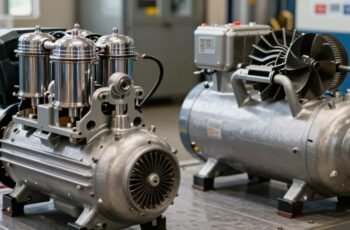
When choosing between budget and premium air compressors, it’s essential to take into account not just initial costs but also long-term performance and reliability. While budget models may seem cost-effective upfront, they often fall short in durability and operational stability. Conversely, premium units come with higher investments but promise efficiency and resilience for demanding tasks. Understanding these differences can influence your decision, especially when the right tool impacts productivity and maintenance expenses over time.
Key Takeaways
- Premium compressors offer better performance, stability, and durability, suitable for continuous, demanding applications.
- Budget units are ideal for light-duty, intermittent tasks with lower initial costs but higher long-term maintenance.
- Advanced features like energy-efficient drives and noise reduction are typically found in premium models.
- Higher upfront costs of premium compressors are offset by lower operational expenses and longer lifespan.
- Properly matching compressor type to application needs maximizes value, performance, and cost-effectiveness.
How Do Budget and Premium Air Compressors Differ in Performance?
While budget air compressors may seem sufficient for light-duty tasks, they often fall short in delivering consistent performance compared to premium models. Budget units typically feature lower-quality components, leading to greater fluctuations in pressure stability and reduced efficiency over time. Their motors generally have less power and durability, causing slower recovery times and increased overheating risks during prolonged use. Additionally, these compressors often operate at higher noise levels and exhibit greater vibration, which can impact precision and comfort. In contrast, premium models incorporate advanced engineering, high-grade materials, and optimized designs that guarantee stable output, faster cycle times, and enhanced longevity. Consequently, performance inconsistencies are minimized, making premium compressors better suited for demanding applications requiring reliable, continuous operation.
What Features Do Premium Air Compressors Offer That Budget Models Lack?
Premium air compressors incorporate a range of advanced features designed to enhance performance, durability, and efficiency—elements often lacking in budget models. These features enable more precise control, longer operational lifespan, and better energy management. For example, premium units often include variable speed drives that maximize power consumption, reducing operational costs. They also feature high-quality components such as cast iron cylinders and industrial-grade valves, which improve longevity and reduce downtime. Additionally, enhanced cooling systems maintain ideal operating temperatures, preventing overheating during extended use. Finally, integrated digital controls and monitoring systems offer real-time diagnostics, facilitating maintenance and minimizing unexpected failures.
- Variable speed drives for energy efficiency
- Heavy-duty, corrosion-resistant components
- Advanced thermal management systems
- Real-time digital monitoring and diagnostics
How Much Should You Expect to Spend on a Quality Air Compressor?
Expect to invest between $1,000 and $5,000 for a high-quality air compressor, depending on its specifications and intended applications. Factors influencing cost include horsepower, tank capacity, duty cycle, and added features like variable speed drive or advanced cooling systems. Commercial-grade models with higher CFM ratings and enhanced durability naturally command premium prices. Conversely, models designed for light-duty tasks or less demanding environments tend to fall into the lower end of this range. Precise budgeting requires evaluating operational needs against these technical parameters, ensuring that investment aligns with performance expectations. While initial costs are significant, selecting an appropriately rated compressor minimizes downtime and maintenance expenses, ultimately providing better value over its lifecycle. Properly calibrated spending guarantees reliable performance tailored to specific industrial or professional requirements.
Which Use Cases Are Best Suited for Budget vs. Premium Compressors?
Understanding the distinctions between industrial and light-duty applications, as well as continuous versus intermittent use, helps determine whether a budget or premium compressor is appropriate. Budget models often suffice for low-frequency, light tasks, whereas premium units are better suited for demanding, continuous operations. Analyzing these specific use cases allows for a more informed selection aligned with operational requirements.
Industrial vs. Light Duty
While budget air compressors can efficiently handle light-duty tasks, their suitability diminishes when subjected to the demands of industrial applications. Industrial environments require compressors with higher durability, continuous operation capabilities, and precise pressure regulation, often found in premium models. Conversely, light-duty tasks, such as small maintenance or hobbyist projects, benefit from lower-cost options that provide sufficient performance without excessive features.
- Designed for intermittent use and lower pressure demands
- Built with lighter materials, reducing durability under heavy loads
- Limited cooling systems, risking overheating in continuous use
- Lower overall lifespan and fewer advanced control features
Understanding these distinctions helps determine whether a budget or high-end compressor aligns with specific operational requirements, ensuring maximum performance and cost-effectiveness.
Continuous vs. Intermittent Use
The operational demands of continuous versus intermittent use considerably influence the choice between budget and premium air compressors. Continuous operation requires reliable, high-capacity units capable of maintaining consistent pressure over extended periods, making premium compressors more suitable due to their durability, advanced cooling systems, and superior components. These features minimize downtime and reduce maintenance costs, ensuring efficiency in demanding applications. Conversely, intermittent use involves sporadic or short bursts of operation, where budget compressors can suffice. Their simpler design, lower initial cost, and adequate performance for short durations make them a practical choice for light tasks. Ultimately, understanding the operational frequency and load demands guides the selection, aligning compressor capabilities with application needs and cost considerations.
How Do Durability and Maintenance Costs Compare Between Budget and Premium Options?
When comparing durability, premium compressors typically feature higher-quality components that extend operational lifespan and resist wear better than budget models. Maintenance costs often reflect these differences, with premium units requiring fewer repairs and less frequent servicing over time. Analyzing these factors helps determine the true long-term value of each option.
Long-Term Durability Differences
Since durability directly impacts long-term operational costs, understanding how budget and premium air compressors compare in this regard is essential. Premium models generally feature higher-quality components, enhanced manufacturing precision, and superior materials, resulting in increased lifespan. Budget options often utilize less durable parts, which are more susceptible to wear and failure over time, reducing operational longevity.
- Material quality of critical components
- Manufacturing tolerances and assembly precision
- Resistance to operational stress and environmental factors
- Expected service life and failure rates
Maintenance Cost Variations
Durability directly influences maintenance costs, as components prone to wear require more frequent repairs or replacements. Budget compressors typically use lower-grade parts, leading to higher maintenance frequency and costs over time. Conversely, premium models feature durable components designed for longevity, reducing repair needs and associated expenses. The table below illustrates these differences:
| Aspect | Budget Compressors | Premium Compressors |
|---|---|---|
| Replacement Frequency | Higher | Lower |
| Maintenance Costs | Higher over lifespan | Lower over lifespan |
| Component Longevity | Shorter | Extended |
Ultimately, while initial costs are lower for budget options, long-term maintenance expenses tend to favor premium models due to their superior durability and reduced repair frequency.
What Are the Key Factors to Consider When Choosing Between Budget and Premium Models?
Choosing between budget and premium air compressors requires a careful assessment of several critical factors that directly impact performance and long-term value. Key considerations include reliability, efficiency, build quality, and feature set. Reliability determines operational uptime and maintenance needs, with premium models typically offering longer service life. Efficiency impacts energy consumption and operating costs; higher-end units often deliver superior performance with lower energy waste. Build quality influences durability, especially under continuous use, favoring premium options. Finally, feature sets such as pressure regulation, control systems, and safety mechanisms can considerably affect usability and safety.
- Reliability and longevity
- Energy efficiency and operating costs
- Build quality and durability
- Advanced features and control options
How Important Is Noise Level When Selecting an Air Compressor?
Noise level is a critical factor in selecting an air compressor because it directly affects the working environment and operator safety. Excessive noise can lead to hearing loss, fatigue, and decreased concentration, increasing the risk of accidents. In industrial settings, high noise levels can also violate regulatory standards, resulting in potential fines. From an operational perspective, quieter compressors tend to produce less vibration, reducing mechanical wear and extending equipment lifespan. Premium models often incorporate noise-reduction technologies, such as sound enclosures and vibration isolation, which are less common in budget options. Consequently, evaluating noise output isn’t just about comfort; it’s a crucial safety and longevity consideration that influences overall productivity and compliance. Selecting a compressor with an appropriate noise profile is essential for a safe, efficient work environment.
Are Energy Efficiency and Running Costs Better in Premium Compressors?
While premium compressors often come with a higher upfront cost, their superior energy efficiency and lower operating expenses can justify the investment over time. These units typically incorporate advanced motor technologies and optimized airflow designs, reducing energy consumption during operation. Consequently, operational costs decrease, leading to significant savings in the long run.
Key factors include:
- Reduced power consumption due to advanced motor efficiency
- Lower maintenance needs, minimizing downtime and repair costs
- Better thermal management, decreasing energy loss
- Increased operational lifespan, delaying replacement expenses
How Do Warranty and Customer Support Vary Between Budget and Premium Brands?
Premium compressors generally offer more extensive warranty coverage and superior customer support compared to budget options. This often translates into longer warranty periods, covering major components, and prompt service responses. Budget brands typically provide limited warranties, focusing on basic coverage, which may not extend to all critical parts. Customer support in premium brands tends to include dedicated helplines, technical assistance, and faster resolution times, whereas budget brands may rely on generic channels with longer wait times. The table below compares these aspects:
| Feature | Budget Compressors | Premium Compressors |
|---|---|---|
| Warranty Duration | 1-2 years | 3-5 years |
| Component Coverage | Limited | Extensive |
| Customer Support | Basic support, slow responses | Dedicated support, quick responses |
| Service Response Time | Longer delays | Faster, prioritized assistance |
This distinction impacts reliability, maintenance, and overall user experience.
Which Air Compressor Price Range Offers the Best Value for Your Needs?
Evaluating cost-effectiveness requires analyzing initial investment against long-term operational costs and reliability. We need to contemplate how different price ranges align with specific application requirements, ensuring the compressor’s capacity and durability match usage demands. This approach helps identify which price segment provides ideal value for the intended tasks.
Cost Effectiveness Analysis
Determining the most cost-effective air compressor requires analyzing how different price ranges align with specific operational needs and long-term value. Budget models typically offer lower upfront costs but may incur higher maintenance and energy expenses over time. Premium units often have higher initial investments but provide enhanced durability, efficiency, and reduced downtime, leading to potential savings. To evaluate cost-effectiveness, consider:
- Initial purchase price versus expected lifespan
- Energy consumption efficiency over operational hours
- Maintenance and repair costs over the equipment’s lifetime
- Downtime and productivity impacts due to reliability issues
This analysis helps identify which compressor delivers the most advantageous balance between upfront investment and ongoing operational costs, ensuring the best value aligned with your specific application demands.
Suitability for Applications
Choosing the right air compressor depends heavily on the specific requirements of your application, as different price ranges offer distinct advantages aligned with operational needs. Budget compressors typically suffice for light-duty tasks like small tools or occasional use, offering basic reliability but limited capacity and durability. Conversely, premium models deliver higher flow rates, greater pressure stability, and enhanced build quality, making them suitable for continuous operation in demanding environments. For industrial applications requiring precision, longevity, and minimal downtime, investing in premium compressors provides better long-term value despite higher upfront costs. Meanwhile, less intensive tasks may not justify the expense of premium units. Ultimately, matching the compressor’s specifications to the application’s workload guarantees ideal performance and cost efficiency.
Frequently Asked Questions
How Do Size and Portability Differ Between Budget and Premium Air Compressors?
Premium air compressors typically offer larger sizes and reduced portability, designed for stationary use, whereas budget models are more compact and lightweight, prioritizing portability for simple tasks, but often at the expense of power and capacity.
Are There Specific Industries or Tasks Better Suited for Budget or Premium Models?
Certain industries and tasks benefit from premium compressors, like automotive and manufacturing, due to their reliability. Budget models suit light-duty tasks like hobbyist projects or occasional home use, offering cost-effective solutions with adequate performance.
What Safety Features Are Typically Included in Premium Air Compressors?
Premium air compressors typically include safety features like thermal overload protection, pressure relief valves, automatic shutoff systems, and vibration dampening. These enhancements help prevent accidents, guarantee operational stability, and prolong equipment lifespan, making them essential for demanding industrial applications.
Can Budget Compressors Handle Professional or Heavy-Duty Use Effectively?
Budget compressors can handle light to moderate tasks, but they often falter with frequent, heavy-duty use. We recommend premium models for professional, persistent, and powerful performance, ensuring efficiency, durability, and dependable operation under demanding conditions.
How Does the Availability of Spare Parts Differ Between Budget and Premium Brands?
Premium brands typically offer more readily available spare parts due to larger distribution networks and manufacturer support, ensuring quicker repairs and higher reliability. Budget brands may have limited spare parts, causing potential delays and increased downtime during maintenance or repairs.
Conclusion
Ultimately, choosing between budget and premium air compressors is like selecting the right tool for a precision job—cutting corners may save money upfront but can lead to costly failures down the line. We’ve seen how investing in quality often pays off through increased durability, efficiency, and lower maintenance costs, especially in demanding applications. By carefully weighing your specific needs and long-term value, you’ll guarantee your compressor supports your operations reliably, much like a finely tuned machine that keeps your workflow running smoothly.