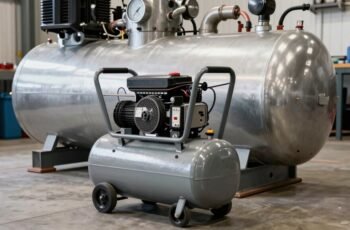
When selecting an industrial air compressor, understanding the fundamental differences between rotary and reciprocating types is essential for optimizing performance and cost efficiency. Each design offers distinct mechanical characteristics, operational advantages, and limitations that directly impact application suitability. As we analyze these systems in detail, key factors such as efficiency, maintenance, and environmental considerations come into focus—factors that can ultimately influence your choice in ways that may not be immediately apparent.
Key Takeaways
- Rotary compressors provide continuous, smooth airflow with lower vibration, ideal for steady, high-volume applications.
- Reciprocating compressors are better suited for high-pressure, intermittent tasks requiring precise control.
- Rotary units generally have higher initial costs but lower maintenance and energy costs over time.
- Reciprocating compressors are typically easier to repair, with more accessible components, but may have higher downtime.
- Rotary compressors operate more quietly and efficiently in environments demanding low noise and consistent performance.
What Are Rotary and Reciprocating Compressors? An Overview
Have you ever wondered how industrial air compressors generate the high-pressure air necessary for various manufacturing processes? Rotary and reciprocating compressors are two primary types, each with distinct mechanisms. Rotary compressors utilize a rotating element—such as screws, vanes, or lobes—to continuously compress air, offering smooth, steady airflow with high efficiency in large-scale applications. Conversely, reciprocating compressors operate through a piston-cylinder arrangement, where reciprocating motion compresses air in discrete strokes, making them suitable for lower flow rates or high-pressure demands. Both types are engineered with precision components to optimize performance, durability, and energy consumption. Understanding these fundamental differences helps in selecting the appropriate compressor based on operational requirements, maintenance considerations, and system integration.
How Do Rotary and Reciprocating Compressors Work? Key Mechanical Differences
To understand the fundamental mechanical differences between rotary and reciprocating compressors, it’s essential to examine their core operational principles. Rotary compressors operate via continuous, meshing rotating elements—such as screws, lobes, or vanes—that trap and compress air through a persistent sealing action. This results in a smooth, steady flow with minimal pulsation. Conversely, reciprocating compressors utilize pistons driven by a crankshaft within cylinders, performing sudden, cyclical compression strokes. This creates a pulsating airflow characterized by distinct intake and compression phases. Mechanically, rotary units feature sealed, rotating parts with complex gear or screw arrangements, while reciprocating units depend on reciprocating motion of pistons, valves, and cylinders. These fundamental differences influence efficiency, maintenance, and operational characteristics, shaping their suitability for specific industrial applications.
Which Applications Suit Rotary Compressors Best? Advantages and Use Cases
Rotary compressors excel in applications requiring continuous, stable airflow due to their ability to operate smoothly with minimal pulsation. Their design provides consistent pressure and efficiency, making them ideal for long-term, steady-state operations. They are particularly well-suited for environments where downtime is costly, and reliability is critical. Key applications include:
- Manufacturing lines with constant demand
- HVAC systems requiring steady airflow
- Process industries needing reliable compressed air
- Automotive assembly plants with continuous operation
Their ability to deliver a uniform air supply reduces system vibrations and wear, extending equipment lifespan. Additionally, rotary compressors are favored in settings where energy efficiency and low maintenance are priorities, ensuring best performance over extended periods.
When Are Reciprocating Compressors the Right Choice? Benefits and Typical Tasks
Reciprocating compressors are the ideal choice when applications demand high-pressure output, precise control, and short bursts of compressed air. Their design allows for high-pressure efficiencies, often exceeding 300 psi, making them suitable for tasks requiring exact pressure regulation. These compressors excel in applications where rapid cycling and variable load demands are common, such as in maintenance shops, laboratory settings, and small-scale manufacturing. Their reciprocating piston mechanism provides fine-tuned pressure adjustments, essential for sensitive equipment. Additionally, their modular construction facilitates straightforward maintenance and repairs. While less efficient for continuous, large-volume airflow, reciprocating compressors deliver reliable, high-pressure performance for specialized, short-duration tasks where precision and control outweigh long-term energy consumption.
Comparing Efficiency and Power Consumption of Rotary vs Reciprocating Compressors
While both rotary and reciprocating compressors convert power into compressed air, their efficiencies and power consumption profiles differ considerably due to their distinct operational mechanisms. Rotary compressors typically operate with higher volumetric efficiency and lower energy losses, especially at steady loads, thanks to continuous operation. Reciprocating compressors, however, often exhibit higher peak power usage during compression strokes but can be more energy-efficient at variable loads due to their ability to modulate output.
- Rotary compressors excel in continuous operation with consistent power draw
- Reciprocating units are more suitable for intermittent, high-pressure demands
- Rotary designs generally consume less energy per unit of compressed air at constant load
- Reciprocating compressors tend to have higher initial efficiency but increased overall power consumption during cycling
Maintenance and Reliability: What to Expect From Each Compressor Type
When evaluating maintenance requirements, rotary and reciprocating compressors differ considerably in frequency and complexity, impacting ongoing operational costs. Reliability and downtime risks vary between the two, with each type presenting distinct long-term cost implications. Understanding these factors helps optimize lifecycle management and minimize unexpected failures.
Maintenance Frequency and Complexity
Understanding the maintenance demands of industrial air compressors requires examining both the frequency and complexity of service tasks associated with each type. Reciprocating compressors typically demand more frequent inspections due to their reciprocating pistons and valves, which are prone to wear. Maintenance tasks include valve adjustments, piston ring replacements, and lubrication checks, often on a weekly or monthly basis. Conversely, rotary compressors generally require less frequent maintenance, primarily involving oil changes and filter replacements, usually on a quarterly or semi-annual schedule. The complexity of service also varies: reciprocating units involve intricate mechanical adjustments, while rotary units feature sealed systems with modular components that simplify maintenance.
- Reciprocating units need frequent, detailed inspections
- Rotary units typically require less frequent maintenance
- Mechanical complexity is higher in reciprocating compressors
- Rotary compressors favor straightforward, modular servicing
Reliability and Downtime Risks
Reciprocating compressors tend to exhibit higher failure rates and more frequent downtime due to their mechanically complex components and wear-prone parts, such as valves and piston rings. These moving parts are subject to cyclic stress, leading to increased fatigue and potential failure. The presence of multiple seals and bearings further raises the risk of leaks and mechanical breakdowns, which can result in unplanned shutdowns. Additionally, piston rings and valves experience wear over time, reducing efficiency and increasing maintenance needs. In contrast, rotary compressors, with fewer moving parts and continuous operation, generally offer enhanced reliability. Their design minimizes vibration and mechanical stress, leading to reduced failure rates and consistent uptime. Overall, reciprocating units demand more frequent inspections and repairs, heightening operational downtime risks.
Long-term Cost Considerations
While initial purchase price often influences equipment selection, long-term costs related to maintenance and reliability substantially impact overall operational expenses. Rotary compressors tend to have higher upfront costs but typically require less frequent maintenance and exhibit greater durability, reducing downtime. Conversely, reciprocating compressors often have lower initial costs but incur higher ongoing maintenance due to more wear-prone components.
Key considerations include:
- Maintenance intervals: Rotary units generally need scheduled service less frequently.
- Component wear: Reciprocating compressors experience higher wear on valves and pistons.
- Downtime costs: Increased reliability of rotary compressors minimizes operational interruptions.
- Repair expenses: Reciprocating units often demand more costly repairs over their lifespan.
Understanding these factors helps optimize total cost of ownership and operational efficiency.
Cost Considerations: Buying, Operating, and Upkeep of Rotary and Reciprocating Models
We need to compare the initial purchase costs of rotary and reciprocating compressors, considering their differing complexity and capacity ranges. Operating expenses, including maintenance requirements and energy consumption, profoundly influence total cost of ownership. Analyzing energy efficiency savings over time can further clarify which model offers better long-term financial viability.
Purchase Price Differences
Although initial purchase prices for rotary and reciprocating air compressors can vary considerably, understanding the full cost implications requires analyzing not only the upfront investment but also the ongoing expenses associated with operation and maintenance. Typically, rotary compressors have higher initial costs due to their advanced technology, precision components, and superior build quality. Conversely, reciprocating models generally feature lower purchase prices but may incur higher long-term costs through increased energy consumption and maintenance needs. Key considerations include:
- Initial equipment cost: Rotary units often cost 30-50% more upfront.
- Component durability: Rotary compressors tend to have longer-lasting parts.
- Technological complexity: Advanced features can inflate initial prices.
- Economies of scale: Larger units usually present better cost efficiencies in rotary models.
Careful analysis of these factors helps in making an economically sound choice.
Maintenance Cost Factors
Maintenance costs for rotary and reciprocating air compressors are influenced by a range of factors, including component durability, complexity of design, and accessibility for repairs. Rotary compressors typically feature sealed, low-wear components such as bearings and rotors, reducing frequency and cost of part replacements. Conversely, reciprocating models rely on piston rings, valves, and cylinders, which experience higher wear rates, increasing maintenance intervals and expenses. The complexity of a rotary system often demands specialized skills for repairs, elevating labor costs, whereas reciprocating units’ simpler design allows for more straightforward servicing. Accessibility also impacts costs: rotary compressors generally have enclosed housings, complicating repairs and increasing downtime, while reciprocating units are usually easier to access, reducing service time. Overall, these factors notably shape ongoing maintenance expenditures.
Energy Efficiency Savings
Have you considered how energy efficiency impacts the overall cost of owning and operating air compressors? Rotary compressors generally deliver higher efficiency, reducing ongoing energy expenses, while reciprocating models tend to consume more power under similar conditions. The efficiency gap influences long-term operational costs considerably. Key factors include:
- Continuous operation of rotary compressors results in lower energy consumption per cubic foot of compressed air.
- Reciprocating units often require frequent cycling, increasing energy use during start-up and shut-down phases.
- Variable speed drives in rotary models optimize power use based on demand, enhancing savings.
- Maintenance routines can impact efficiency, as poorly maintained units lose performance and consume more energy.
Ultimately, selecting a model with superior energy efficiency can yield substantial savings over its lifespan, offsetting initial costs.
Noise Levels and Operating Environment Compatibility of Both Compressor Types
When evaluating compressor options for industrial applications, it’s essential to take into account their noise emissions and compatibility with various operating environments. Rotary compressors tend to operate more quietly due to their continuous, smooth motion, making them suitable for noise-sensitive settings. Reciprocating compressors, however, generate higher noise levels because of piston action and vibration, often requiring soundproofing measures. Environmental factors also influence suitability; rotary units excel in continuous, low-maintenance operation, while reciprocating units adapt better to intermittent, high-pressure demands.
| Compressor Type | Typical Noise Level (dB) | Suitable Environments | Maintenance Frequency | Vibration Levels |
|---|---|---|---|---|
| Rotary | 70-85 | Manufacturing plants, clean environments | Low | Low |
| Reciprocating | 85-95 | Construction sites, high-pressure applications | High | High |
How to Decide Between Rotary and Reciprocating Air Compressors for Your Business
When choosing between rotary and reciprocating compressors, we assess initial costs, ongoing maintenance, and operational complexity to determine economic feasibility. We evaluate application-specific requirements, such as pressure and flow demands, to match the compressor type with intended use. This systematic approach guarantees an informed decision aligned with both technical specifications and budget constraints.
Cost and Maintenance
Choosing between rotary and reciprocating air compressors requires a careful analysis of their associated costs and maintenance demands, as these factors considerably impact operational efficiency and long-term expense. Reciprocating compressors typically involve higher maintenance costs due to more complex valve systems, piston wear, and frequent part replacements. They also tend to have higher initial purchase prices for larger units. Rotary compressors generally offer lower maintenance needs, thanks to fewer moving parts and sealed designs, but they can have higher upfront costs.
Key considerations include:
- Maintenance frequency and complexity
- Part replacement costs
- Initial purchase price
- Operational energy efficiency
Ultimately, rotary compressors often prove more cost-effective over time for continuous operation, while reciprocating units may be suitable for intermittent or smaller-scale needs.
Application Suitability
Determining the most suitable air compressor type for your business hinges on carefully evaluating your operational demands, load patterns, and application-specific requirements. Rotary compressors excel in continuous, high-volume operations due to their ability to deliver stable airflow with minimal pulsation, making them ideal for manufacturing, automation, and process industries. Conversely, reciprocating compressors are better suited for intermittent or low-volume tasks, where precise pressure control and rapid startup are essential. They handle varying load conditions effectively but tend to be noisier and require more maintenance. Consider the nature of your application’s demand profile—steady versus fluctuating loads—and required airflow rates. By aligning your operational needs with the compressor’s performance characteristics, you can optimize efficiency, reliability, and overall system integration.
Common Challenges and Troubleshooting Tips for Rotary and Reciprocating Compressors
Despite their robust design, rotary and reciprocating compressors often encounter specific operational challenges that can impact efficiency and reliability. Common issues include excessive vibration, overheating, abnormal noise, and pressure fluctuations. Troubleshooting begins with inspecting wear parts such as valves, pistons, and seals, which often cause performance degradation. Regular lubrication checks are essential to prevent friction-related failures. For overheating, verify cooling system integrity and airflow; for vibration and noise, ensure proper alignment and balance. Pressure inconsistencies may indicate leaks or control system faults.
Rotary and reciprocating compressors face challenges like vibration, overheating, noise, and pressure fluctuations affecting performance.
- Check and replace worn or damaged components
- Maintain accurate lubrication and cooling systems
- Guarantee proper alignment and mounting
- Monitor system pressure and temperature parameters
Frequently Asked Questions
Which Compressor Type Is More Environmentally Friendly?
We believe rotary compressors are more environmentally friendly due to their higher efficiency, lower energy consumption, and reduced emissions. Their continuous operation minimizes waste, making them a sustainable choice, especially in large-scale industrial applications requiring consistent, eco-conscious performance.
How Do Startup and Shutdown Procedures Differ?
We observe that startup and shutdown procedures differ mainly in complexity; rotary compressors typically require minimal steps with automatic controls, whereas reciprocating compressors involve detailed procedures to guarantee safety and prevent mechanical stress during start-up and shut-down.
What Are the Space Requirements for Each Compressor?
Rotary compressors generally occupy less space due to their compact design, while reciprocating units require larger footprints for their cylinders and ancillary components; space planning must consider maintenance access and vibration mitigation for both types.
Can Rotary and Reciprocating Compressors Be Combined?
Yes, rotary and reciprocating compressors can be combined, often in staged setups, to optimize efficiency, reduce wear, and meet variable pressure demands. Proper integration requires careful control systems, ensuring seamless operation and balanced airflow across both compressor types.
What Are the Typical Lifespan Differences?
Rotary compressors typically last 10-20 years, thanks to fewer moving parts and lower wear, while reciprocating units usually endure 8-15 years due to higher mechanical stress and more frequent maintenance needs.
Conclusion
In choosing between rotary and reciprocating compressors, we see a clear contrast: rotary models excel in continuous, efficient operation with lower maintenance, ideal for manufacturing, while reciprocating units offer precise control for high-pressure, short-term tasks despite higher noise and maintenance demands. Ultimately, the decision hinges on your application’s specific needs, operational volume, and environmental constraints. Carefully analyzing these factors ensures peak performance, cost-efficiency, and longevity for your compressed air system.