While it might seem straightforward to choose between stationary and portable air compressors, the decision involves nuanced considerations that can greatly impact operational efficiency. We recognize the importance of aligning equipment with specific application demands, and understanding these differences can ultimately influence long-term productivity. As we explore the contrasting design features, suitable applications, and economic factors, you’ll find that making an informed choice requires a thorough analysis of your unique needs.
Key Takeaways
- Stationary compressors are larger, more durable, and designed for continuous, heavy-duty industrial use, while portable models are lightweight and ideal for temporary tasks.
- Stationary units offer higher capacity and stability but lack mobility, whereas portable compressors are easy to transport and suitable for remote or outdoor applications.
- Fixed compressors typically consume more power and have higher initial costs but provide long-term operational efficiency; portable units are more affordable initially.
- Maintenance for stationary compressors is more complex and frequent, while portable models are simpler to maintain but may require more frequent checks for leaks and hoses.
- Choose stationary compressors for large-scale, continuous operations; opt for portable models for flexibility, quick deployment, and short-term use.
How Do Stationary and Portable Air Compressors Differ in Design?
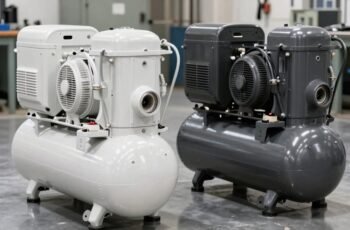
How do stationary and portable air compressors differ in design? Stationary models feature robust, heavy-duty frames with integrated components that prioritize stability and durability for continuous use. They typically have larger tanks, which minimize pressure fluctuations and extend operational periods, and are built with reinforced materials to withstand industrial environments. Portable compressors, by contrast, emphasize compactness and mobility; they incorporate lightweight materials, integrated handles, and wheels for ease of transport. Their tanks are smaller, designed for quick, intermittent use, and components are optimized for minimal size without compromising essential performance. The fundamental design divergence lies in their structural emphasis—stationary units focus on stability and capacity, while portable units prioritize lightweight construction and maneuverability for versatile deployment.
Which Applications Are Best Suited for Stationary Air Compressors?
Stationary air compressors are best suited for applications that demand consistent, high-volume airflow and long operational periods. They excel in manufacturing environments, where continuous operation supports assembly lines, automated machinery, and industrial tools. Their robust construction and larger capacity enable sustained performance without frequent maintenance interruptions. Additionally, stationary compressors are ideal for applications requiring precise pressure control and stable airflow, such as welding, paint spraying, and large-scale pneumatic systems. Their fixed installation allows for integration into centralized systems, reducing downtime and maximizing efficiency. The ability to handle high power loads and operate continuously makes stationary compressors indispensable in heavy-duty industrial settings, where reliability and consistent performance are critical to maintaining productivity and minimizing operational costs.
When Should You Choose a Portable Air Compressor?
Choosing a portable air compressor becomes vital when flexibility, ease of transport, and on-the-spot power are priorities. These models are ideal for dynamic work environments where mobility is essential, such as construction sites, roadside repairs, or remote maintenance tasks. They offer quick setup and can be easily moved between locations, reducing downtime. Portable compressors excel in applications requiring intermittent use or lower air volume, where a stationary unit’s capacity may be unnecessary. Additionally, their compact design allows for storage in tight spaces and simplifies handling. However, they are generally less powerful and have smaller tanks, making them unsuitable for continuous or heavy-duty tasks. Overall, selecting a portable compressor aligns with needs emphasizing mobility, rapid deployment, and operational convenience.
What Are the Key Advantages and Drawbacks of Stationary Models?
Stationary models benefit from a stable power supply, ensuring consistent operation for demanding tasks. They also tend to offer increased durability and longer service life due to robust construction. However, their limited portability can restrict use to fixed locations, posing challenges for applications requiring mobility.
Stable Power Supply
A significant advantage of stationary air compressors is their ability to guarantee a consistent and stable power supply, which is essential for continuous operation in industrial settings. This stability reduces fluctuations that can disrupt processes or damage equipment. However, the reliance on a fixed power source limits flexibility and increases installation complexity. The table below outlines key aspects:
| Aspect | Advantage | Drawback |
|---|---|---|
| Power Stability | Ensures uninterrupted operation | Limited mobility, fixed location |
| Energy Efficiency | Optimized for prolonged, consistent use | Higher initial setup costs |
| Operational Reliability | Less prone to voltage fluctuations or dips | Dependence on stable electrical infrastructure |
Increased Durability and Longevity
Because stationary air compressors are designed for continuous, heavy-duty operation, they generally offer superior durability and a longer lifespan compared to portable models. Their robust construction involves high-quality components and reinforced frames, which withstand prolonged use and operational stresses effectively. These compressors often feature heavy-duty motors and larger cooling systems that mitigate thermal degradation over time, extending their service life. Additionally, stationary units benefit from reduced vibration and mechanical wear due to secure mounting and higher-quality materials. However, this increased durability comes with higher initial investment costs and more complex maintenance requirements. Overall, their design focus on longevity makes stationary compressors ideal for industrial settings where consistent, long-term performance is critical, though at the expense of flexibility and ease of relocation.
Limited Portability Options
The inherent bulk and fixed installation requirements of stationary air compressors considerably limit their portability, making them less adaptable for tasks that demand frequent relocation or outdoor use. Their size and weight hinder quick setup and transport, often requiring specialized equipment or infrastructure. This restricts their deployment to permanent or semi-permanent locations, reducing operational flexibility. While stationary models excel in providing consistent, high-volume airflow, their limited mobility can be a significant drawback in dynamic work environments. This inflexibility can lead to increased downtime and logistical challenges, especially when multiple sites or outdoor tasks are involved. Consequently, although stationary compressors offer durability and power, their limited portability constrains versatility, making them less suitable for applications requiring frequent movement or remote operation.
What Are the Pros and Cons of Using Portable Air Compressors?
Portable air compressors offer significant flexibility and convenience for various tasks, but they also come with specific limitations. Their compact design allows for easy transport, enabling use across multiple job sites without the need for dedicated power sources or infrastructure. This mobility enhances efficiency, especially in remote or temporary settings. However, their smaller size typically restricts airflow capacity and maximum pressure output, which can limit performance in demanding applications. Additionally, portable units often have shorter operational runtimes due to smaller tanks and less robust components, requiring more frequent breaks for rest or refilling. While their versatility is advantageous, these trade-offs necessitate careful consideration of task scope and workload to make certain that a portable compressor’s capabilities align with project requirements.
How Do Cost, Power, and Maintenance Compare Between the Two Types?
When comparing stationary and portable air compressors, we observe distinct differences in initial costs, energy use, and maintenance demands. Stationary units typically require higher upfront investments but often feature lower operational costs over time, whereas portable models tend to be more affordable initially but may incur higher maintenance expenses. Analyzing these factors helps determine which type offers better efficiency and long-term value for specific applications.
Initial Purchase Expenses
Although stationary and portable air compressors vary considerably in design, their initial purchase expenses are primarily influenced by differences in cost, power requirements, and maintenance needs. Stationary units typically entail higher upfront costs due to larger components, more robust construction, and advanced features suited for continuous operation. Conversely, portable compressors usually have lower initial prices, reflecting their smaller size, lighter materials, and simplified design. Power requirements also influence initial expenses; stationary models often demand dedicated electrical setups or fuel sources, increasing initial investment. Maintenance costs are less relevant at purchase but can impact overall expense, with stationary units generally requiring more durable, high-capacity parts. Overall, stationary compressors present a higher initial financial commitment, whereas portable units offer a lower entry point with reduced initial costs.
Power Consumption Differences
While stationary air compressors generally consume more power due to their larger motors and continuous operation capabilities, portable units tend to be more energy-efficient for intermittent use. Stationary models often operate at higher power levels to sustain prolonged tasks, leading to increased operational costs. Portable units, designed for short bursts, optimize energy consumption and reduce overall electricity expenses.
| Feature | Stationary Compressors | Portable Compressors |
|---|---|---|
| Power Consumption | Higher due to larger motors | Lower, optimized for short use |
| Operational Efficiency | Continuous, consumes more energy | Intermittent, conserves energy |
| Cost Implication | Higher energy costs over time | Lower energy bills for sporadic use |
| Usage Pattern | Heavy-duty, long-term | Light, occasional tasks |
| Maintenance Costs | Slightly higher due to continuous operation | Lower, simpler systems |
Maintenance Requirements
Maintenance requirements for stationary and portable air compressors differ significantly in aspects of cost, complexity, and operational demands. Stationary units typically require more detailed upkeep, including regular oil changes, filter replacements, and inspections of belts and electrical components, which increase overall maintenance costs. Their larger size and integrated systems necessitate specialized skills and sometimes professional service, raising operational complexity. Conversely, portable compressors generally demand less routine maintenance due to their smaller, more straightforward design. They often feature fewer moving parts and simplified lubrication schedules, reducing both cost and time investment. However, portable units may need more frequent checks for leaks, hoses, and connectors because of their mobility and exposure to varied environments. Overall, stationary compressors incur higher ongoing expenses, while portability simplifies maintenance but may require more frequent inspections.
Which Factors Should Influence Your Decision Between Stationary and Portable?
Choosing between a stationary and a portable air compressor hinges on several vital factors that directly impact functionality, efficiency, and overall suitability for specific tasks. First, consider the scale and complexity of your operations; larger, continuous tasks favor stationary models due to their higher capacity and durability. Portables excel in versatility, ideal for tasks requiring mobility or space constraints. Power source availability is also essential—stationary units often connect to fixed electrical systems, while portables typically run on gas or batteries. Noise levels and environmental conditions influence your choice, as stationary compressors tend to be quieter and suited for indoor use. Additionally, budget constraints and long-term maintenance costs can sway decisions, with stationary units generally demanding higher initial investment but lower operational costs over time.
Frequently Asked Questions
How Long Do Stationary and Portable Air Compressors Typically Last?
Stationary compressors usually last 10-20 years with proper maintenance, while portable units typically last 5-10 years. We recommend regular servicing and careful operation to maximize lifespan for both types, ensuring reliable performance over time.
Are There Safety Concerns Unique to Stationary or Portable Models?
Like maneuvering differing terrains, stationary compressors pose fall hazards from elevated placements, while portable models risk tip-overs and manual handling injuries. We emphasize proper safety protocols, regular maintenance, and awareness to mitigate these specific risks effectively.
Can Portable Compressors Handle Continuous Operation?
Portable compressors can handle continuous operation if designed for high-duty cycles, but they generally have limitations due to size and cooling capacity, making them less suitable for prolonged, heavy-duty tasks compared to stationary models with advanced cooling systems.
What Are the Noise Level Differences Between the Two Types?
Portable compressors generally operate at higher noise levels, often between 70-90 decibels, due to their smaller size and less sound insulation, whereas stationary models typically feature soundproofing, resulting in markedly lower noise emissions.
How Do Storage Requirements Differ for Each Compressor Type?
Stationary compressors typically require dedicated, spacious storage areas due to their size and weight, whereas portable units are designed for compact storage, easily transported, and stored in smaller spaces, making them more flexible for varied operational environments.
Conclusion
In summary, choosing between stationary and portable air compressors hinges on your specific needs. Studies show that around 60% of industrial users prefer stationary units for their reliability and capacity, while 40% favor portability for flexibility in varied tasks. By analyzing factors like application scale, mobility requirements, and maintenance costs, you can make an informed decision. Prioritizing the right compressor ensures maximum performance, efficiency, and long-term cost savings tailored to your operational demands.