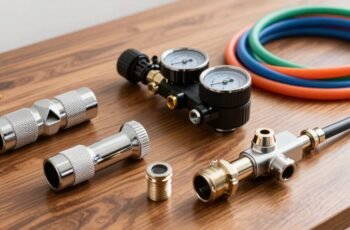
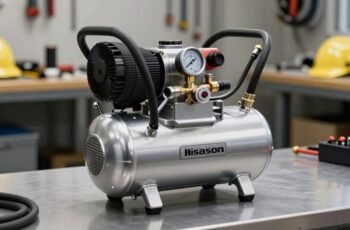
Charting the world of nail gun air compressors is like plotting a course through a complex landscape—every feature and specification can significantly impact your workflow. We understand that choosing the right unit isn’t just about price but involves analyzing capacity, portability, noise, and maintenance needs. As we break down these critical factors, you’ll see how making informed choices can lead to more efficient, long-lasting results—if you’re willing to consider all the details, the perfect match might just be within reach.
Key Takeaways
- Match CFM and PSI ratings to your nail gun’s requirements for optimal performance.
- Choose tank size based on workload to reduce cycling and ensure consistent pressure.
- Consider portability features like weight, handles, and wheels for ease of transport between sites.
- Opt for quieter models below 85 dB and assess maintenance needs for durability.
- Balance price, features, and warranty to maximize value and long-term reliability.
What Features Make a Nail Gun Air Compressor Ideal for Your Projects
When selecting a nail gun air compressor, understanding the key features that align with your specific projects is vital. First, consider the compressor’s CFM (cubic feet per minute) output, which determines how quickly it can supply air to your nail gun. Higher CFM is necessary for continuous, heavy-duty tasks, while lower CFM suffices for light use. Next, evaluate the tank size; larger tanks provide more consistent pressure and reduce cycling, increasing efficiency. Portability features, such as weight and handle design, matter if you move between job sites frequently. Additionally, noise levels can impact your work environment—look for models with quieter operation if noise is a concern. Overall, selecting features tailored to your workload guarantees maximum performance and durability.
How to Determine the Right Capacity and Pressure Settings for Your Needs
Determining the right capacity and pressure settings for your needs requires a clear understanding of your specific projects’ demands and the specifications of your nail gun. Capacity, measured in gallons, indicates the compressor’s air storage, which affects how often it cycles on and off during operation. For high-volume tasks or continuous use, a larger tank (6-8 gallons) minimizes downtime. Pressure, measured in PSI, must meet or slightly exceed your nail gun’s requirements—typically around 90-120 PSI. Confirming your compressor can consistently deliver this pressure under load is vital for peak performance and avoiding misfires or jams. Analyzing your project scope and matching it with the compressor’s capacity and pressure capabilities ensures efficient workflow and prevents equipment strain or failure.
Key Factors to Consider When Choosing Portability and Size
Choosing the right size and portability for your air compressor involves carefully evaluating how you plan to use it and the physical constraints of your workspace. Portability depends on weight, size, and mobility features, while size influences capacity and power. Consider whether you need a compact unit for tight spaces or a portable model for job-site flexibility.
| Feature | Consideration | Impact |
|---|---|---|
| Weight | Lighter units are easier to carry | Enhances mobility for frequent moves |
| Size | Compact design fits limited spaces | Improves maneuverability |
| Mobility Features | Wheels, handles, portability accessories | Facilitates transportability |
Assess these factors against your specific tasks to optimize efficiency and ease of use.
Understanding Noise Levels and Maintenance Requirements in Nail Gun Compressors
Understanding noise levels and maintenance requirements is essential for selecting a nail gun compressor that balances user comfort with long-term reliability. Lower noise levels reduce fatigue and improve safety, especially in enclosed spaces. When evaluating noise, consider decibel ratings; compressors below 85 dB are generally quieter. Maintenance involves regular tasks such as oil changes, filter replacements, and drain valve checks. Failure to maintain can lead to decreased performance and costly repairs. Key points include:
- Decibel ratings indicating noise output
- Oil-lubricated vs. oil-free models, affecting maintenance frequency
- Ease of access for routine upkeep to minimize downtime
Tips for Comparing Prices and Finding the Best Value for Your Budget
When comparing nail gun air compressors, balancing performance features with cost is key to guaranteeing you get the best value for your investment. We recommend analyzing the compressor’s specifications against its price, focusing on durability, airflow, and tank capacity. Look for models that offer essential features without unnecessary extras that inflate costs. To assist, here’s a comparison template:
| Feature | Price Range |
|---|---|
| Airflow (CFM) | $100 – $300 |
| Tank Capacity (Gallons) | $120 – $350 |
| Noise Level (dB) | $90 – $250 |
| Portability | $100 – $280 |
| Warranty | $80 – $200 |
This structured approach ensures you prioritize value, not just price, leading to a well-informed purchase.
Frequently Asked Questions
How Long Does It Typically Take to Fill the Air Tank?
It usually takes about 1 to 3 minutes to fully fill a typical nail gun air compressor tank, depending on its size and the compressor’s output capacity, with larger tanks naturally requiring more time to reach ideal pressure.
Can I Use a Single Compressor for Multiple Nail Gun Types?
Like a Swiss Army knife, you can use a single compressor for multiple nail gun types if it provides sufficient CFM and PSI. We analyze each tool’s requirements to guarantee compatibility, avoiding pressure drops or performance issues.
What Safety Features Should I Look for in an Air Compressor?
We prioritize safety features like automatic shut-off, thermal overload protection, pressure regulation, and durable safety valves, ensuring reliable operation and user protection. These aspects help prevent accidents, maintain ideal performance, and extend the compressor’s lifespan.
How Do Temperature Variations Affect Compressor Performance?
Temperature variations can cause a 10-15% efficiency drop in compressors, as hot air reduces condensation and cooling rates. We analyze how extreme cold or heat impacts internal components, affecting longevity and consistent performance, urging careful environmental control.
Are There Recommended Brands Known for Durability and Reliability?
We recommend brands like Bostitch, Makita, and Porter-Cable for durability and reliability. They consistently produce high-quality compressors with sturdy components, rigorous testing, and solid warranties, ensuring long-term performance even under demanding conditions.
Conclusion
As we navigate the landscape of nail gun air compressors, remember that choosing the right model is akin to selecting the perfect tool to craft a masterpiece—each feature, from capacity to noise level, plays a crucial role. By weighing specifications meticulously and balancing cost with durability, we guarantee our investments stand the test of time. In this pursuit, knowledge is our compass, guiding us through the intricate maze toward precision, efficiency, and lasting performance.