Choosing the right air compressor for automotive work requires a clear understanding of your specific tool requirements, including airflow and pressure needs. We need to contemplate factors like power source, tank size, noise levels, and safety features, all while balancing budget constraints. Making informed decisions here is critical for reliable performance and efficiency, but the best choice depends on many nuanced details that warrant careful evaluation before investing.
Key Takeaways
- Match the compressor’s CFM and PSI ratings to the maximum requirements of your automotive tools.
- Choose the right compressor type (reciprocating, rotary screw, vane) based on task frequency, noise, and maintenance.
- Consider portability features like tank size, wheels, and power source for your workspace environment.
- Ensure safety features, durability, and ease of maintenance to prolong compressor life and ensure safe operation.
- Balance your budget with essential features such as auto shut-off, pressure regulation, and noise levels for efficiency.
What Are the Key Types of Air Compressors for Automotive Work?
When selecting an air compressor for automotive work, understanding the key types available is essential for ensuring the right tool for the job. The primary types include reciprocating piston compressors, rotary screw compressors, and rotary vane compressors. Reciprocating piston compressors are common in garages due to their portability and high-pressure output, making them suitable for tire inflation and spray painting. Rotary screw compressors operate continuously and are ideal for extended use, providing steady airflow with lower noise levels, suitable for spray booths and pneumatic tools. Rotary vane compressors, though less common, offer reliable performance at moderate capacities. Each type varies in efficiency, maintenance needs, and cost, so choosing the appropriate compressor depends on specific automotive tasks and operational demands.
How Do You Determine the Right CFM and PSI for Your Needs?
To determine the right CFM (cubic feet per minute) and PSI (pounds per square inch) for your needs, it’s essential to analyze the specific requirements of your tools and applications. Start by identifying the maximum CFM and PSI ratings specified by each tool’s manufacturer, focusing on the most demanding device you plan to operate. For continuous operation, select an air compressor that provides at least 25-30% higher CFM than your highest tool requirement to ensure consistent performance and avoid pressure drops. For PSI, ensure the compressor can reach the maximum PSI needed for your tasks, with some margin for safety. Precise matching prevents underperformance, reduces wear, and optimizes energy efficiency, ensuring your compressor meets your automotive work demands reliably.
Which Power Source and Portability Features Matter Most?
Choosing the appropriate power source and portability features is crucial for peak compressor performance and convenience. We must consider options such as electric, gas, or battery power, depending on the work environment. Additionally, understanding mobility features like weight, size, and transport options ensures the compressor meets site demands efficiently.
Power Source Options
Considering the diverse applications of air compressors, selecting the appropriate power source is essential for ensuring ideal performance and convenience. The primary options include electric motors, gas engines, and PTO (power take-off) drives. Electric compressors provide consistent power, are quieter, and require an electrical outlet, making them suitable for indoor or fixed automotive workshops. Gas-powered units offer portability and independence from electrical supply, ideal for outdoor or remote use but generate more noise and emissions. PTO-driven compressors connect directly to a vehicle’s power system, delivering continuous, high-capacity airflow, suitable for heavy-duty tasks. Each power source impacts operational efficiency, noise levels, and mobility. Consequently, understanding your typical work environment and load demands is critical for selecting the most compatible power source for automotive applications.
Portability Needs
The type of power source directly influences how easily an air compressor can be moved and used across different work environments. For portability, selecting the appropriate power source is vital.
- Electric models are lightweight and ideal for fixed or semi-fixed locations, but require access to power outlets.
- Gas-powered units offer mobility without cords, suitable for remote or outdoor applications, but tend to be heavier.
- Battery-operated compressors provide the highest portability, enabling cordless operation, though they typically have limited run times.
- Air tank size impacts portability; smaller tanks are easier to transport, while larger tanks deliver more continuous air but are less mobile.
Prioritizing these features ensures the compressor meets your mobility requirements for automotive tasks.
Mobility Features
What power source best aligns with your mobility needs when selecting an air compressor? For on-the-go automotive work, portability and energy source are critical. Gas-powered compressors offer independence from electrical outlets, ideal for remote locations, but tend to be heavier and noisier. Electric compressors provide cleaner operation and are suitable for workshop environments with power access; portable models often feature handles or wheels for easy transport. Battery-powered units deliver true mobility without cords or fuel, though they have limited run time and require battery management. Consider your typical work environment and the weight-to-power ratio. A compact, lightweight design with durable wheels and integrated handles enhances maneuverability. Ultimately, balancing power source and portability features ensures efficient, flexible operation tailored to your automotive tasks.
What Size and Tank Capacity Should You Choose?
Selecting the appropriate compressor size and tank capacity depends on your specific airflow and pressure requirements for intended tasks. We must consider how much volume and pressure are necessary to maintain consistent operation without excessive cycling. Properly matching these factors guarantees efficiency and minimizes downtime during use.
Suitable Compressor Size
How do you determine the appropriate compressor size and tank capacity for your needs? The key factors include airflow requirements, duty cycle, and application scope. To select the correct compressor size:
- Calculate the total CFM (cubic feet per minute) needed for all tools in use simultaneously.
- Choose a compressor with a duty cycle that exceeds your maximum operational load—ideally 100% for continuous use.
- Match the compressor’s CFM rating to your highest tool demand, ensuring it can sustain performance.
- Opt for a tank capacity that allows for minimal cycling, typically 4-6 times the compressor’s CFM output, to improve efficiency and longevity.
Precise matching prevents over-sizing and ensures reliable performance for automotive tasks.
Tank Capacity Needs
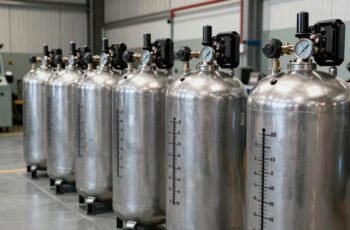
Determining the appropriate tank capacity hinges on understanding your operational demands and minimizing compressor cycling, which affects both efficiency and component lifespan. For automotive tasks requiring continuous or frequent use, a larger tank—typically 20 to 60 gallons—ensures a steady air supply and reduces compressor on/off cycles. Short, intermittent tasks, such as tire inflation or light sanding, can often be managed with smaller tanks of 10 to 20 gallons. Larger tanks provide a buffer that stabilizes pressure and decreases wear on the compressor motor, extending its service life. Conversely, smaller tanks are more portable and suitable for mobile or space-constrained environments. Ultimately, selecting a tank size aligned with the workload ensures ideal performance, energy efficiency, and equipment longevity.
Airflow and Pressure
When choosing an air compressor, understanding the relationship between airflow and pressure is essential to meet your operational requirements effectively. Airflow, measured in CFM (cubic feet per minute), determines how much air the compressor delivers, while pressure, measured in PSI (pounds per square inch), indicates the force exerted. Selecting the right size depends on your tools’ demand and usage duration.
Key considerations include:
- Tool requirements – Match compressor CFM and PSI to tool specifications.
- Duty cycle – Higher duty cycles require larger tanks and higher flow rates.
- Operational efficiency – Guarantee continuous operation without excessive compressor cycling.
- Tank capacity – Larger tanks support steady airflow, reducing pressure fluctuations during prolonged use.
How Do Noise Levels and Space Constraints Influence Your Choice?
Noise levels and space constraints are critical factors that directly influence the selection of an air compressor. High noise emissions can create an uncomfortable or unsafe work environment, especially in enclosed or shared spaces, necessitating models with sound attenuation features or quieter operation ratings. Space limitations demand compact, vertically oriented units or portable designs that fit within designated areas without compromising functionality. Additionally, considering the compressor’s footprint is essential to guarantee adequate airflow and accessibility for maintenance. We must assess the environment’s acoustic requirements and spatial constraints to choose an appropriately sized, low-noise unit that integrates seamlessly into the workspace. Proper evaluation of these factors helps optimize efficiency, safety, and comfort during automotive tasks.
What Are the Important Safety and Maintenance Considerations?
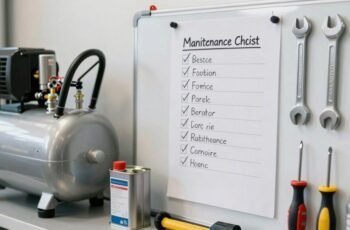
Safety and maintenance considerations are fundamental to guaranteeing the reliable operation and longevity of an air compressor. Proper adherence reduces risk and minimizes downtime. Key factors include:
- Regular Inspection: Monitor hoses, fittings, and safety valves for wear, leaks, or damage, replacing components as necessary.
- Pressure Settings: Ensure pressure relief valves are functional and set within manufacturer specifications to prevent over-pressurization.
- Lubrication and Cooling: Maintain proper lubrication schedules and clean cooling elements to prevent overheating and component failure.
- Electrical Safety: Verify wiring insulation and grounding to prevent electrical hazards, and disconnect power before performing maintenance.
Following these steps guarantees safe operation and prolongs equipment lifespan, safeguarding both personnel and your investment.
How Can You Balance Budget and Quality When Buying?
Balancing budget and quality when purchasing an air compressor requires careful evaluation of features, materials, and manufacturer reputation to guarantee a cost-effective investment. Prioritize components such as motor durability, tank construction, and airflow capacity, aligning with your automotive tasks. Investing in reputable brands often guarantees better longevity and fewer maintenance issues, even if initial costs are higher. Consider the following comparison:
| Feature | Budget Option | Higher-Quality Option |
|---|---|---|
| Motor Durability | Basic motor, shorter lifespan | Heavy-duty motor, extended life |
| Material Quality | Thin metals, cheaper components | Sturdy, corrosion-resistant parts |
| Performance | Adequate for small tasks | Consistent, high airflow for demanding tasks |
This approach guarantees a balanced, informed purchase tailored to your needs.
Which Additional Features Make a Difference for Automotive Tasks?
When selecting an air compressor for automotive tasks, additional features that enhance efficiency and convenience can considerably impact overall performance. These features optimize workflow, reduce downtime, and improve safety.
- Auto Shut-Off: Prevents overheating and saves energy by turning off when not in use.
- Pressure Regulation: Ensures consistent output pressure, critical for precision tasks like tire inflation and spray painting.
- Mobility Options: Casters or lightweight design facilitate easy transport within the workspace.
- Quick-Connect Couplers: Allow rapid attachment and detachment of tools, streamlining multiple operations.
Prioritizing these features guarantees the compressor adapts effectively to automotive environments, maximizing productivity and tool reliability.
Frequently Asked Questions
Can I Use a Home Garage Air Compressor for Professional Automotive Work?
We can use a home garage air compressor for professional automotive work if it meets the required CFM, PSI, and duty cycle specifications. Otherwise, it might lack the durability and power needed for continuous, high-demand tasks.
How Often Should I Perform Maintenance on My Air Compressor?
Like a finely tuned instrument, we recommend inspecting and replacing filters, draining moisture, and checking belts monthly, or after heavy use, to guarantee ideal compressor performance and longevity, preventing costly repairs and downtime.
What Are the Best Brands or Models for Automotive Air Compressors?
We recommend brands like Porter-Cable, California Air Tools, and Ingersoll Rand for automotive air compressors due to their durability, high performance, and reliable customer support, ensuring consistent operation and long-term value in automotive workshops.
Is It Better to Buy a New or Used Air Compressor?
We recommend buying a new air compressor for reliability and warranty coverage. Used units may save money but often lack recent maintenance or parts, risking inconsistent performance and potential breakdowns, which could compromise your automotive tasks.
How Do I Properly Store and Winterize My Air Compressor?
We recommend draining moisture, disconnecting power, and storing in a dry, sheltered location. Winterizing involves adding antifreeze to the tank and checking for leaks, ensuring the best compressor performance and preventing damage during cold months.
Conclusion
Choosing the right air compressor is crucial, much like selecting the perfect instrument for a symphony—each component must harmonize with your needs. By carefully considering factors like CFM, PSI, power source, and safety features, we guarantee peak performance and longevity. Just as a craftsman appreciates precision, our informed choices lead to efficiency and reliability, transforming automotive tasks from routine to refined. In this pursuit, we craft not just repairs, but mastery.