While the smallest tools often seem the most convenient, the most powerful engine air compressors prove otherwise. They’re essential for a variety of jobs, from construction to industrial maintenance, and choosing the right one can be a complex decision. With so many options available, understanding what makes a compressor suitable for your needs is vital. Keep exploring to discover the models that truly can power up any job you undertake.
Key Takeaways
- Consider compressor power source options like gas-powered, electric, or hybrid for suitability across different jobs.
- Evaluate tank capacity and pressure ratings to match the scope of your tasks, from light repairs to heavy-duty industrial use.
- Check compatibility with engine models and specifications to ensure proper installation and reliable operation.
- Prioritize portability features such as handles and weight for on-the-go jobs or fixed setups for stationary applications.
- Review durability and maintenance requirements, especially for heavy-duty and vehicle-specific compressors, to ensure long-term performance.
DeWalt 4 Gallon Gas-Powered Oil-Free Air Compressor
The DeWalt 4 Gallon Gas-Powered Oil-Free Air Compressor stands out as an excellent choice for professionals and DIY enthusiasts who need reliable power on the go. Its Honda GX160 OHV 163cc gas engine features a precision camshaft design, ensuring efficient valve timing and better fuel economy. With air flows of 6.9 SCFM at 40 psi and 5.0 SCFM at 90 psi, it handles a variety of pneumatic tools effortlessly. The oil-free, low-maintenance pump and direct drive system make it reliable and easy to operate. Its portable design, equipped with pressure gauges, a regulator, and quick coupler, makes it ideal for job sites and rooftops alike.
Best For: professionals and DIY enthusiasts who need a portable, reliable air compressor for construction sites, rooftops, and various pneumatic tool applications.
Pros:
- Powerful Honda GX160 engine with efficient fuel consumption
- Compact and portable design for easy transportation and use on job sites
- Low-maintenance, oil-free pump ensures reliable operation with minimal upkeep
Cons:
- Limited 4-gallon tank capacity may require frequent refilling for continuous use
- Heavier compared to electric compressors, potentially more challenging to carry over long distances
- Gas-powered operation may produce noise and emissions, less suitable for indoor or noise-sensitive environments
150 PSI Aluminum Air Compressor with 1.6 Gal Tank
For those seeking a reliable, heavy-duty air compressor, the 150 PSI Aluminum Air Compressor with a 1.6-gallon tank delivers powerful performance and durability. It’s designed for easy setup with clear instructions and all necessary components included, making installation quick across various vehicles like trucks, boats, and trailers. With a maximum pressure of 150 PSI and capacity to handle intermittent pressures up to 250 PSI, it’s perfect for demanding tasks such as tire inflation and powering air tools. Its high-strength aluminum tank guarantees longevity and resilience under tough conditions, while its IP54 rating guards against dust and water, ensuring dependable operation in harsh environments.
Best For: DIY enthusiasts, professional mechanics, and fleet operators seeking a durable, high-performance air compressor for heavy-duty vehicle maintenance and tire inflation.
Pros:
- Easy to install with clear instructions and all necessary components included
- Capable of handling high pressures up to 150 PSI and intermittent pressures up to 250 PSI
- Durable high-strength aluminum tank resistant to demanding environments
Cons:
- Limited to a 1.6-gallon tank, which may not be sufficient for continuous heavy use
- Slightly heavier due to metal construction, potentially impacting portability
- Requires adequate power source and space for installation in tight vehicle compartments
Air Brake Compressor for Detroit Diesel Series 60
If you own a Freightliner truck with a Detroit Diesel Series 60 12.7 engine, this air brake compressor is a reliable replacement. Designed specifically for models 2004 and earlier, it offers increased airflow (CFM) for better efficiency. The Series 60 TF-750 compressor is similar to the T-U-FLO-550 but delivers more air output, making it ideal for replacing worn or faulty units. Manufactured by NEWZQ, it weighs around 80.8 pounds and matches OE specifications. This unit fits seamlessly in most Series 60 12.7 engines, ensuring your truck’s air brake system stays reliable and functional.
Best For: truck owners with Detroit Diesel Series 60 12.7 engines (2004 and earlier) seeking a reliable, high-output air brake compressor replacement.
Pros:
- Increased airflow (CFM) for more efficient compressor performance
- OE-matching specifications ensuring compatibility and quality
- Suitable for most Series 60 12.7 engine models up to 2004
Cons:
- Customer review ratings are relatively low at 2.4 out of 5 stars
- Heavy weight of approximately 80.8 pounds may require additional handling care
- Limited to models 2004 and earlier, not compatible with newer engines
Air Compressor Replacement for Caterpillar Engines
When replacing air compressors on Caterpillar engines, choosing a reliable and compatible part is essential for peak performance. The Lamerto Air Compressor, with model numbers 1316679, 131-6679, or CA1316679, is designed specifically for Caterpillar and CAT heavy equipment, including industrial engines, motor graders, trucks, and wheel dozers. It fits models like 621G, 631E, 637G, and engine types such as 3406E and C-15. Made from high-quality materials, each unit undergoes rigorous testing before shipping, ensuring durability and performance. Installation is straightforward, though professional help is recommended. For peace of mind, customer support is readily available to address any questions or concerns.
Best For: those seeking a durable, high-quality air compressor compatible with Caterpillar heavy equipment and engines for reliable performance and easy installation.
Pros:
- Designed specifically for Caterpillar and CAT heavy machinery, ensuring a perfect fit
- Constructed from high-quality materials for enhanced durability and longevity
- Undergoes rigorous testing prior to shipping to guarantee performance
Cons:
- Professional installation is recommended, which may incur additional costs
- Compatibility limited to specified models, not suitable for non-listed equipment
- Availability may be limited depending on supplier stock and location
Unloader Pilot Check Valve & Throttle Cable for Compressors
The Unloader Pilot Check Valve & Throttle Cable streamline compressor operation, making them essential for maintaining reliable startup and shutdown cycles. This all-in-one unit combines a pilot valve, check valve, and unloader valve, ensuring smooth engine control. The 36-inch throttle cable connects to the engine throttle arm, relaying ON/OFF signals based on PSI settings, while the brass construction withstands outdoor environments. With adjustable PSI ratings and optional cable lengths, they suit gas compressors up to 6.5HP. The manual toggle and venting muffler add convenience and durability, helping keep your compressor running efficiently and reliably through every cycle.
Best For: individuals or professionals operating gas air compressors up to 6.5HP who need a reliable, all-in-one unloader and control solution for smooth startup and shutdown cycles.
Pros:
- Combines multiple valve functions into a single, space-saving unit, simplifying installation.
- Adjustable PSI settings and customizable throttle cable lengths for tailored performance.
- Durable brass construction and features like manual toggle and venting muffler enhance longevity and ease of use.
Cons:
- Limited compatibility with compressors larger than 6.5HP.
- May require technical knowledge for proper installation and adjustment.
- Fixed connection port options may necessitate additional adapters for some setups.
VEVOR 2.1 Gal Oil-Free Air Compressor, 1.2HP
The VEVOR 2.1 Gal Oil-Free Air Compressor is ideal for users needing portability and reliable power for various pneumatic tasks. It features a 900W oil-free motor that delivers 2.2 CFM at 90 PSI, with a maximum pressure of 116 PSI, making it versatile for nail guns, impact wrenches, spray guns, and tire inflation. Weighing just 27 pounds and equipped with a handle, it’s easy to transport. Its durable, rust-resistant construction and quiet operation—around 70 decibels—ensure long-lasting performance. Safety features like automatic shutoff and overheating protection add reliability, making it perfect for both professional and DIY projects.
Best For: DIY enthusiasts and professionals seeking a portable, reliable air compressor for various pneumatic tasks such as tire inflation, spray painting, and woodworking.
Pros:
- Compact and lightweight design with a portable handle for easy transportation
- Quiet operation at approximately 70 decibels, reducing noise disturbance
- Durable construction with rust-resistant and wear-resistant coatings for longevity
Cons:
- Limited tank capacity of 2.1 gallons may require frequent refilling for continuous use
- Maximum pressure of 116 PSI might not be sufficient for heavy-duty industrial tasks
- Slightly higher price point compared to basic compressors with similar specs
Metabo HPT 8-Gallon Gas Air Compressor with Honda GX
For demanding professionals needing reliable power, the Metabo HPT 8-Gallon Gas Air Compressor with Honda GX offers robust performance and durability. Its 8-gallon tank and a compression range from 116 to 145 PSI guarantee steady power for tools like nailers used in siding, framing, roofing, and finish work. Powered by a dependable Honda GX engine, it delivers high-performance, long-lasting operation. The cast iron cylinder enhances durability and efficiency, while the integrated control panel protects gauges and regulators. Backed by a 1-year warranty, this compressor combines professional-grade power with user-friendly design, making it an ideal choice for tough job sites.
Best For: professional contractors and serious DIYers who require reliable, high-performance pneumatic power on demanding job sites.
Pros:
- Robust 8-gallon tank with consistent PSI range of 116-145 for steady tool operation
- Powered by a durable Honda GX engine ensuring long-lasting, dependable performance
- Cast iron cylinder enhances durability, efficiency, and long-term use
Cons:
- Heavier and less portable compared to smaller, electric compressors
- Higher maintenance requirements due to gas engine and mechanical components
- Potentially louder operation compared to electric models
Portable Car Jump Starter with Air Compressor
Ideal for roadside emergencies, a portable car jump starter with an air compressor quickly revives dead batteries and inflates tires. With a peak current of 3000A, it supports engines up to 12L gas and 10L diesel, even in extreme temperatures. Its powerful compressor offers four modes—car, motorcycle, bicycle, and basketball—and inflates up to 150 PSI. It’s also a handy power bank with a 12,000mAh battery, charging phones and devices. An LCD display shows battery and pressure levels, while the bright yellow design ensures visibility. Compact and lightweight, it’s a reliable all-in-one tool for emergencies and outdoor adventures.
Best For: outdoor enthusiasts, drivers, and emergency responders seeking a versatile, reliable device for roadside assistance, tire inflation, and portable charging.
Pros:
- Combines jump starter, air compressor, and power bank in one compact device for multi-purpose use.
- Supports engines up to 12L gas and 10L diesel, suitable for most vehicles and extreme temperatures.
- Features an LCD display, LED flashlight, and multiple inflation modes for easy operation and safety.
Cons:
- Weighs approximately 0.7 pounds, which may still be slightly cumbersome for some users during extended outdoor activities.
- Limited to 150 PSI maximum inflation pressure, which might not be sufficient for very high-pressure tires or inflatables.
- Requires manual setup and handling, which could be challenging for users unfamiliar with electronic devices or in stressful situations.
Throttle Control Cable for Gas Air Compressors
Throttle control cables are essential components that guarantee precise engine regulation in gas air compressors, especially for those with 3HP to 6.5HP engines. These cables act as a relay between the unloader and engine throttle arm, controlling engine speed based on pressure fluctuations. Designed with a 36-inch length and a stroke of 0.65 inches, they work with a 1/8 Male NPT inlet connection for compatibility. When pressure reaches unload, pneumatic signals extend the throttle, reducing speed; as load increases, the cable retracts, restoring normal operation. This regulation helps assure efficient compressor performance and longevity.
Best For: users operating gas air compressors with 3HP to 6.5HP engines seeking precise and reliable engine regulation through pressure-controlled throttle management.
Pros:
- Ensures accurate engine speed control based on compressor pressure levels
- Compatible with a variety of compressor setups via standard 1/8 Male NPT connection
- Facilitates efficient compressor operation, extending equipment lifespan
Cons:
- Limited to compressors with specific horsepower range (3HP to 6.5HP)
- Installation may require some technical expertise due to pneumatic connections
- Possible wear of the spring mechanism over prolonged use affecting performance
212cc 7.5HP Gas Engine for Go Karts and Equipment
This 212cc 7.5HP gas engine stands out for its powerful performance, making it perfect for go-karts and small equipment. Its 4-stroke design, horizontal OHV configuration, and air cooling system guarantee reliable operation. With a robust 7.5HP and a maximum torque of 10.8N-m, it delivers strong power for various applications. Built with durable materials like aluminum and iron, it features a forged crankshaft and cast iron cylinder liner for longevity. Compact and lightweight, it’s easy to install and operate. Whether powering a go-kart, compressor, or trencher, this engine offers efficiency, safety, and consistent performance for your projects.
Best For: DIY enthusiasts and small equipment operators seeking a reliable, high-performance engine for go-karts, compressors, and trenchers.
Pros:
- Powerful 7.5HP engine with strong torque of 10.8N-m for versatile applications
- Durable construction with aluminum, iron, forged crankshaft, and cast iron liner for longevity
- Compact, lightweight design makes installation and portability easy
Cons:
- May require regular maintenance due to air cooling system and mechanical components
- Limited fuel tank capacity of 3.6L might necessitate frequent refueling for extended use
- Manual start option might be less convenient compared to fully electric starting systems
Factors to Consider When Choosing Engine Air Compressors
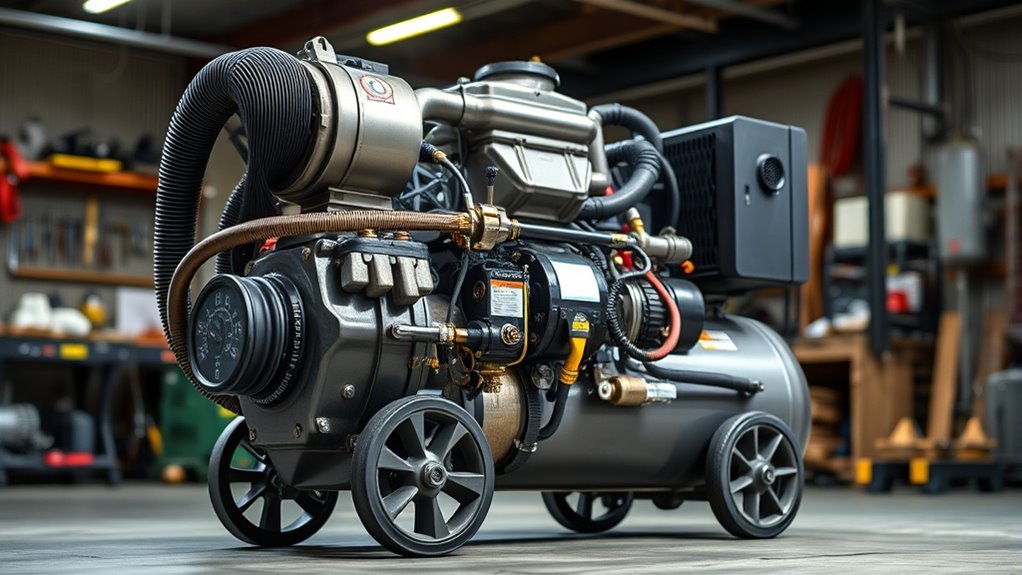
When selecting an engine air compressor, we need to take into account factors like power output to match our specific tasks and guarantee compatibility with existing engines. Portability, size, durability, and the ease of maintenance also play vital roles in making the right choice. By focusing on these points, we can find a compressor that fits both our needs and working conditions perfectly.
Power Output Needs
Choosing the right engine air compressor hinges on understanding your power output needs. First, determine the maximum CFM your tools require to guarantee the compressor can deliver sufficient airflow continuously. Matching the compressor’s PSI rating with your application’s pressure demands is vital for peak performance. For heavy-duty tasks, consider gas-powered compressors with higher horsepower and larger engine displacement, providing the power needed for demanding jobs. It’s also important to evaluate the compressor’s maximum pressure capacity to handle peak demands without overloads or airflow issues. Additionally, think about how often and how long you’ll use the compressor—select a model with a power output that supports your workload for consistent, reliable operation. Properly examining these factors ensures your compressor can meet your specific power needs efficiently.
Compatibility With Engines
Ensuring compatibility between the air compressor and the engine is essential for peak performance and safety. We need to verify that the compressor’s mounting and connection points match the engine’s specifications and design. It’s important to check the bolt pattern, size, and inlet/outlet connections to ensure they align with existing configurations. Additionally, we must confirm that the compressor’s maximum airflow (CFM) and pressure ratings meet the engine’s operational requirements. Compatibility also involves matching the model number and part specifications with the engine’s make, model, and serial number. Finally, we should consider the physical size and weight of the compressor to ensure it fits comfortably within the engine compartment or designated space, preventing installation issues or operational hazards.
Portability and Size
The size and weight of an engine air compressor play a crucial role in how easily it can be transported and stored. Smaller, lightweight models are more portable, often equipped with handles or wheels that simplify moving them across job sites. The tank size also matters—compact tanks are easier to carry and fit into tight spaces but may limit the air supply duration. Portable compressors typically run on standard 110V power, making them versatile for various locations without specialized outlets. The overall design, including size and weight, directly influences how conveniently you can use the compressor in remote or confined environments. Choosing a compact, lightweight model ensures easier handling, storage, and deployment, making it ideal for diverse job settings.
Durability and Build
Durability and build quality are essential factors when selecting an engine air compressor, as they determine how well the unit will withstand tough working conditions. High-quality materials like cast iron cylinders and high-strength aluminum tanks considerably boost longevity. A sturdy build with corrosion-resistant coatings and reinforced components helps the compressor endure harsh environments. Using tested components that meet industry standards ensures reliable performance and safety. Additionally, durable hoses made from high-temperature resistant silicone or stainless steel braided materials prevent leaks and damage over time. Heavy-duty compressors are designed to handle frequent use and high stress, making them ideal for demanding industrial applications. Overall, a solid build foundation ensures your compressor remains dependable, even under rigorous workloads.
Maintenance Requirements
Maintaining an engine air compressor is crucial for keeping it running efficiently and avoiding costly breakdowns. Regular checks of filters, oil levels, and belts are essential for peak performance. Oil-free models require less maintenance but still need periodic inspection of pressure gauges and safety valves. Compressors with higher duty cycles or continuous use need more frequent maintenance to prevent wear and damage. Proper schedules for cleaning, lubricating, and inspecting for leaks or corrosion help extend the compressor’s lifespan and prevent failures. Neglecting maintenance tasks can lead to decreased efficiency and costly repairs down the line. By staying on top of routine care, we guarantee our compressors operate smoothly, last longer, and deliver reliable power for any job.
Price and Warranty
When selecting an engine air compressor, considering both price and warranty helps guarantee you make a smart investment. While it’s tempting to choose a cheaper model, it’s important to evaluate long-term costs like maintenance and replacement parts, which can add up. Check the warranty period; a longer warranty often indicates better manufacturer confidence and offers more protection against defects. Be sure to verify what the warranty covers—parts, labor, or service—to understand the full scope of protection. Comparing warranty terms across different models and brands can help you find the most all-encompassing coverage. Keep in mind that higher-priced compressors may come with extended warranties or additional support, which can be valuable for ensuring long-term reliability and peace of mind.
Frequently Asked Questions
What Maintenance Is Required for Gas-Powered Air Compressors?
We check and change the oil regularly, drain moisture from tanks, replace air filters, inspect belts and hoses, and keep the compressor clean. Regular maintenance guarantees reliable operation and extends the compressor’s lifespan for any job.
How Do I Choose the Right Tank Size for My Needs?
We choose tank size based on our workload—big enough to handle intense jobs without constant restarts, but not so massive it’s a burden to move. We balance capacity and portability for perfect efficiency.
Are Oil-Free Compressors Suitable for Industrial Applications?
Oil-free compressors are suitable for many industrial applications, especially where clean, contaminant-free air is essential. We recommend them for food, pharmaceutical, and electronics industries, but consider your specific needs to guarantee peak performance and durability.
What Safety Precautions Should I Follow When Operating Engine Air Compressors?
When operating engine air compressors, we always wear protective gear, guarantee proper ventilation, read the manual carefully, check for leaks, and keep a safe distance from moving parts. Staying vigilant helps prevent accidents and ensures safe operation.
How Does Ambient Temperature Affect Compressor Performance?
When ambient temperatures rise, compressors can overheat and lose efficiency, as seen in a factory case where high heat caused pressure drops. We monitor temperature and guarantee proper cooling to maintain ideal performance in all conditions.
Conclusion
When it comes to choosing the right engine air compressor, remember that a penny saved is a penny earned. We’ve explored top models suited for every job, from portable units to industrial powerhouses. By considering factors like size, power, and durability, we can find the perfect match. With the right compressor, you’ll be ready to tackle any project with confidence. After all, the right tool makes all the difference—so choose wisely!