When selecting between portable and stationary air compressors, we recognize that each type’s design and capabilities serve different operational needs. Understanding how their structural differences influence performance allows us to match equipment to specific tasks effectively. But beyond size and power, other critical factors come into play, shaping our decision-making process. To optimize efficiency and reliability, it’s essential to explore how these differences impact practical applications and long-term use.
Key Takeaways
- Portable compressors are lightweight and mobile, ideal for on-site, temporary tasks; stationary compressors are large, fixed units suited for continuous, high-volume use.
- Stationary units generally offer higher airflow and pressure capacity, making them suitable for industrial applications, unlike portable models.
- Portable compressors are easier to set up and maintain but have limited power and tank capacity compared to stationary counterparts.
- Stationary compressors require more space and investment but provide long-term reliability and efficiency for demanding tasks.
- The choice depends on mobility needs, task complexity, and required airflow, balancing convenience against capacity and durability.
How Do Portable and Stationary Compressors Differ in Design?
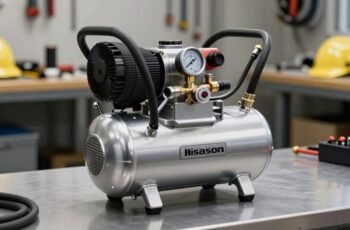
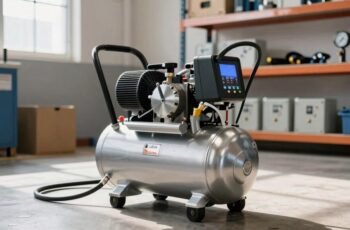
While both portable and stationary compressors serve the same fundamental purpose—compressing air—they differ considerably in their design architecture to meet distinct operational needs. Portable compressors are characterized by compact, lightweight frames, often integrated with built-in handles and wheels to facilitate mobility. They typically feature smaller tanks and simplified pump assemblies, prioritizing ease of transport over continuous operation. In contrast, stationary compressors have larger, more robust frames that support extensive cooling systems and larger tanks, enabling sustained, high-demand performance. Their design emphasizes durability and stability, with components optimized for long-term, fixed installation. The motor configurations also vary; portable units often utilize smaller, lower-power motors, whereas stationary units incorporate heavy-duty motors designed for continuous operation. These fundamental design differences directly influence their respective applications and operational efficiencies.
Which Tasks Are Best Suited for Portable Air Compressors?
Portable air compressors are ideally suited for tasks that require mobility, quick setup, and moderate air demands. They excel in applications where flexibility and rapid deployment are critical, such as roadside repairs, on-site construction, or remote maintenance tasks. These compressors are optimized for tasks that involve inflating tires, powering pneumatic tools like nail guns or impact wrenches, and light-duty cleaning operations. Their compact size facilitates ease of transport and quick relocation, minimizing downtime. Additionally, their moderate airflow capacity ensures they can handle intermittent or continuous use without overwhelming power requirements. However, they are less suitable for high-volume, continuous operations that demand sustained airflow or heavy-duty performance, which are better served by stationary systems.
When Should You Choose a Stationary Air Compressor?
Stationary air compressors are the ideal choice for operations that demand continuous, high-volume airflow and sustained performance. They are best suited for industrial environments where long-term, reliable operation is essential, such as manufacturing plants, workshops, or large-scale construction sites. These compressors provide higher power capacity, often featuring larger tanks and more robust components, allowing for consistent pressure and flow without frequent cycling. Their fixed setup minimizes downtime caused by mobility limitations and simplifies maintenance routines. When the workload involves continuous operation over extended periods or requires precise, stable pressure delivery, stationary compressors guarantee efficiency and operational stability. They are also preferable in scenarios where space permits the installation of permanent equipment designed for high-demand applications.
What Are the Key Advantages and Limitations of Each Type?
Understanding the advantages and limitations of each compressor type helps us determine which is best suited for specific applications. Portable compressors excel in mobility, offering quick setup and ease of transport, but often compromise on power and capacity. Stationary compressors provide high airflow rates and durability, ideal for continuous, high-demand tasks, yet lack portability and require more significant installation space.
Portable compressors offer mobility and quick setup, while stationary units deliver high power and durability for demanding tasks.
Key advantages of portable compressors include:
- Flexibility for varied locations
- Lower initial cost
- Simple maintenance
- Compact design
Limitations involve:
- Limited power output
- Reduced tank capacity
- Shorter operational runtimes
- Less suitable for extensive, continuous use
Conversely, stationary compressors are characterized by:
- High capacity and power
- Long-term reliability
- Greater operational efficiency
- Higher installation cost
How Do Size, Power, and Mobility Influence Your Choice?
When selecting an air compressor, size, power, and mobility are critical factors that directly impact suitability for specific tasks. Larger compressors generally offer higher airflow and pressure, making them ideal for industrial applications, but they lack portability. Conversely, smaller units prioritize mobility and convenience, suitable for maintenance or small-scale tasks. Power determines operational capacity; higher wattage models can sustain continuous use and handle demanding equipment, whereas lower power units are limited to light-duty tasks. Mobility influences deployment flexibility: stationary compressors are fixed installations, offering stability and higher output, while portable units enable quick setups and remote operation. Balancing these factors depends on task complexity, environment constraints, and frequency of use, guiding us to choose the most appropriate compressor for the intended application.
Which Factors Should You Consider to Pick the Right Compressor?
Choosing the right air compressor requires careful consideration of several key factors to guarantee it meets your specific needs. First, we evaluate the required CFM (cubic feet per minute) to assure adequate airflow for your tasks. Second, the operating pressure (PSI) must match your tools’ demands for ideal performance. Third, portability versus stability influences whether a portable or stationary unit fits best, depending on mobility needs. Fourth, energy efficiency and power consumption are critical for long-term operational costs. By analyzing these parameters, we can select a compressor that balances performance, cost, and convenience, guaranteeing it aligns with your application. Making informed decisions based on these factors leads to better productivity and equipment longevity.
Frequently Asked Questions
What Maintenance Practices Are Specific to Portable Versus Stationary Compressors?
We perform routine inspections, oil changes, and filter replacements on portable compressors more frequently due to mobility and exposure to varying environments, while stationary compressors require regular system checks, cooling maintenance, and vibration analysis to guarantee ideal, consistent operation.
Are There Any Safety Concerns Unique to Each Compressor Type?
We recognize that portable compressors pose unique safety risks like tipping or unstable placements, while stationary units may involve hazards from electrical connections or confined space operation; understanding these differences helps us implement targeted safety protocols effectively.
How Do Noise Levels Compare Between Portable and Stationary Models?
Like a whispering wind versus a roaring storm, portable compressors tend to produce higher noise levels, making them less suitable for noise-sensitive environments, while stationary models often operate more quietly, ideal for continuous, professional use.
Can Portable Compressors Handle Continuous Operation Effectively?
Portable compressors can handle continuous operation effectively when equipped with adequate cooling systems and higher-capacity motors, but they generally have limitations compared to stationary units, which are designed for sustained use, making them more reliable for long-term, continuous tasks.
What Is the Typical Lifespan of Each Type of Compressor?
Typically, portable compressors last around 5 to 10 years, while stationary ones often exceed 10 years with proper maintenance. We find that durability depends heavily on usage frequency, environmental conditions, and routine upkeep, influencing their operational lifespan considerably.
Conclusion
Ultimately, choosing between portable and stationary compressors depends on your specific needs. Imagine a compact unit ready to spring into action at a roadside, versus a robust station silently powering an industrial plant. By analyzing factors like size, power, and mobility, you can select the right tool for your workload. Precision in this decision guarantees efficiency, durability, and peak performance—aligning your compressor choice with your operational demands and keeping your projects moving smoothly.