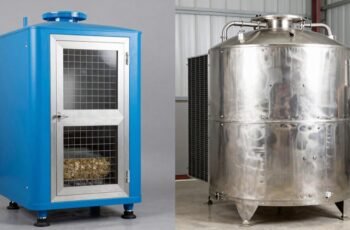
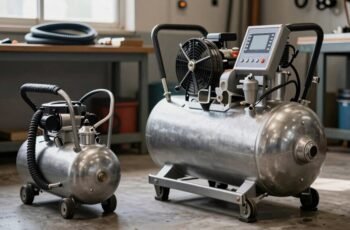
Imagine two compressors standing side by side—one compact and upright, the other sprawling horizontally across the workshop floor—each designed with distinct operational strengths. As we analyze their structural differences, we uncover how form influences function, space utilization, and maintenance. Understanding these nuances is essential for selecting the right model, especially when considering the specific demands of your application. The decision isn’t just about size but about optimizing performance and efficiency in your environment.
Key Takeaways
- Vertical compressors save space with a compact, upright design, ideal for limited areas, while horizontal units require more floor space for stability.
- Vertical models offer better stability and easier handling in confined spaces, whereas horizontal compressors are more mobile and suited for continuous operation.
- Horizontal compressors provide easier access for maintenance and servicing due to their modular design, compared to vertically stacked units.
- Vertical compressors typically have higher initial costs but lower long-term operational expenses due to easier maintenance.
- Choose vertical models for space-constrained, mobile setups; opt for horizontal units for high-capacity, permanent industrial applications.
What Are Vertical and Horizontal Air Compressors?
Vertical and horizontal air compressors are distinguished primarily by their orientation, which affects their design, footprint, and application suitability. Vertical compressors are built upright, optimizing space efficiency and often simplifying maintenance access. They tend to have a smaller footprint, making them ideal for limited spaces, and their design can facilitate better heat dissipation. Horizontal compressors, on the other hand, are laid out flat, typically offering easier component access and straightforward installation in larger, open areas. They usually provide increased stability and capacity options, suitable for continuous industrial use. Both types serve specific operational needs, with the choice largely influenced by space constraints, maintenance requirements, and capacity demands. Understanding these fundamental differences helps us select the appropriate compressor for varied industrial and commercial applications.
Key Differences in Design and Orientation
We observe that vertical and horizontal compressors differ markedly in space efficiency and footprint, affecting installation options in confined settings. Stability and mobility also vary, with vertical units typically offering better stability while horizontal models provide easier transportation. Analyzing these design distinctions helps determine the most suitable orientation for specific operational requirements.
Space Efficiency and Footprint
How does the orientation of an air compressor influence its space efficiency and overall footprint? Vertical compressors generally occupy less horizontal space, making them ideal for limited-floor environments. Their upright design allows for a narrow footprint, which maximizes available workspace and facilitates easier placement in tight areas. Conversely, horizontal compressors tend to have a broader base, consuming more floor space but often integrating more components within a compact horizontal layout, which can streamline maintenance access. The vertical orientation also promotes better vertical clearance utilization, freeing up floor area for other equipment. From a design perspective, the footprint directly impacts installation flexibility, with vertical models suited for confined spaces and horizontal models better for open areas requiring broader support structures.
Stability and Mobility
The design orientation of an air compressor considerably influences its stability and mobility, factors crucial for safe and efficient operation. Vertical compressors typically have a lower center of gravity, enhancing stability on uneven surfaces and reducing the risk of tipping over during operation. Their upright stance allows for better weight distribution, which is advantageous in fixed installations. Conversely, horizontal compressors generally offer greater mobility due to their compact, lightweight design, making them easier to transport and reposition. However, they may require additional stabilization measures when stationary. The choice between vertical and horizontal orientations hinges on balancing stability needs with mobility requirements, especially in environments where frequent relocation or space constraints are prioritized. Understanding these design implications helps optimize compressor performance and safety.
How Space Efficiency Varies Between Vertical and Horizontal Models
Vertical and horizontal air compressor models differ markedly in their space efficiency, impacting installation and workspace management. Vertical units typically occupy less floor space, making them suitable for compact or crowded environments. Their upright design allows for easier stacking or placement in tight corners, maximizing vertical clearance. Conversely, horizontal models often require a broader footprint, which can limit placement options but may facilitate easier access to components for maintenance. The orientation influences airflow and heat dissipation, with vertical models often benefiting from natural convection, reducing cooling requirements. However, horizontal units can be more stable on uneven surfaces, potentially reducing vibration-related space constraints. Overall, the choice hinges on available space, operational layout, and maintenance considerations, with vertical models offering superior space efficiency in constrained environments.
Portability and Mobility: Which Orientation Is Easier to Move?
When evaluating portability, weight distribution and handling are critical factors that influence ease of movement. Vertical models often concentrate weight at the base, making them easier to stabilize and carry, while horizontal units may have a broader footprint that complicates mobility. Additionally, space efficiency and storage considerations can impact how readily a compressor can be relocated or stored when not in use.
Weight Distribution and Handling
Evaluating the weight distribution of an air compressor reveals significant implications for its portability and ease of handling. Vertical compressors tend to concentrate mass at the base, offering a lower center of gravity that improves stability during movement but can increase the effort needed to lift or carry. Horizontal units, however, distribute weight more evenly across their length, which can make handling more balanced but less stable when moving. The orientation impacts the design of handles, casters, and overall maneuverability. Vertical models often feature built-in handles aligned with the base, facilitating vertical lifting, while horizontal units may require additional lifting points or carts. Overall, understanding weight distribution helps determine which orientation minimizes strain and enhances mobility in practical applications.
Space Efficiency and Storage
What factors determine how easily an air compressor can be moved or stored? Space efficiency and storage considerations depend heavily on the compressor’s orientation, impacting footprint and stacking options. Vertical compressors often occupy less floor space and can be stacked or stored vertically, making them ideal for confined areas. Horizontal models tend to have a broader footprint, requiring more surface area but offering easier access for maintenance and connection points. When evaluating portability, the compressor’s base design influences maneuverability, especially during transportation or repositioning.
- Compact dimensions and footprint
- Stacking or vertical storage options
- Accessibility for maintenance and connections
Maintenance and Accessibility: Which Compressor Is More User-Friendly?
Determining which compressor design offers superior maintenance and accessibility hinges on analyzing their component layout and ease of serviceability. Horizontal compressors typically feature a more spacious, modular design, allowing easier access to internal parts, filters, and valves. Their layout facilitates straightforward component replacement and routine inspections, reducing downtime. Conversely, vertical compressors often have a more compact, stacked arrangement, which can restrict access, especially in confined spaces. While their vertical orientation may simplify certain tasks, it can complicate maintenance due to limited component visibility and reach. Overall, horizontal compressors generally provide a more user-friendly experience for maintenance, enabling quicker servicing and fewer disassembly requirements. This makes them preferable in environments prioritizing minimal downtime and ease of routine upkeep.
Ideal Applications for Vertical Air Compressors
Vertical air compressors are ideally suited for applications with space constraints or where installation flexibility is essential. Their compact footprint allows for easier integration into tight or congested environments, making them ideal for workshops, manufacturing lines, or small-scale facilities. The vertical orientation also facilitates easier maintenance and reduces the need for extensive clearance around the unit. Their design lends itself well to applications requiring mobility or temporary setup, such as construction sites or mobile service units. Additionally, the vertical configuration minimizes vibrations and noise transmission to surrounding structures.
- Suitable for confined spaces with limited floor area
- Facilitates quick maintenance and inspection
- Adaptable for mobile or temporary installations
Ideal Applications for Horizontal Air Compressors
Horizontal air compressors are particularly well-suited for applications that demand high capacity and stability over extended periods. Their design allows for larger tanks, which provide consistent airflow and reduce cycling frequency, making them ideal for continuous operation. Industries such as manufacturing, automotive repair, and construction benefit from their ability to sustain high pressure levels without fluctuations. Additionally, horizontal models often feature reinforced frames and robust components, enhancing durability during prolonged use. Their layout facilitates easier maintenance and component access, minimizing downtime. While their footprint may be larger, the stability and capacity advantages outweigh space considerations in fixed installations. Overall, horizontal compressors excel in environments requiring reliable, steady airflow at high volumes, supporting demanding industrial processes with efficiency and longevity.
Factors to Consider When Choosing Between Vertical and Horizontal Models
When selecting between vertical and horizontal air compressor models, it’s essential to evaluate factors such as available space, operational capacity, and maintenance requirements. Vertical models often suit limited space environments due to their compact footprint, whereas horizontal units typically offer easier access for maintenance and repairs. Capacity considerations include airflow rate and pressure needs; larger operations may favor horizontal units for their scalability. Maintenance complexity varies, with vertical models sometimes requiring specialized handling due to their orientation.
Vertical compressors save space but may need special handling; horizontal units ease maintenance and scalability.
- Space constraints impact model orientation choice, favoring vertical units in tight environments.
- Operational capacity must align with airflow demands, influencing size and design.
- Maintenance accessibility and complexity affect long-term servicing efficiency and downtime.
Cost Comparison and Long-Term Investment Value
Evaluating the cost comparison and long-term investment value of air compressors requires a detailed analysis of initial purchase prices, operational expenses, and maintenance costs over the equipment’s lifespan. Vertical models often have higher upfront costs but lower footprint and easier maintenance, which can reduce long-term expenses. Horizontal models typically have lower initial prices but may incur higher costs due to space requirements and more complex maintenance.
| Aspect | Vertical Compressor | Horizontal Compressor |
|---|---|---|
| Initial Cost | Usually higher | Usually lower |
| Maintenance & Space | Easier, less space-consuming | More complex, requires more space |
| Operating Expenses | Potentially lower over lifespan | Potentially higher over lifespan |
| Long-Term Value | Better suited for space-limited applications | Cost-effective initially, less so long-term |
Frequently Asked Questions
Which Compressor Type Has a Longer Lifespan Under Heavy Usage?
Vertical compressors generally have a longer lifespan under heavy use due to better heat dissipation and reduced stress on components. We recommend choosing vertical models for durability in demanding applications, ensuring reliable performance and extended operational life.
How Do Noise Levels Compare Between Vertical and Horizontal Compressors?
Vertical compressors generally operate quieter than horizontal ones due to their compact design and better vibration absorption, reducing noise levels. We analyze that their vertical orientation often results in less sound emission, making them preferable in noise-sensitive environments.
Are There Specific Safety Concerns Unique to Each Orientation?
Vertical compressors pose stability risks if not properly secured due to their height, while horizontal models may present tripping hazards from extended components; both require careful placement and regular maintenance to mitigate safety concerns effectively.
Can Vertical Compressors Be Converted or Adapted to Horizontal Models?
Vertical compressors can often be adapted to horizontal models through modifications to mounting brackets and connection points, but we recommend consulting manufacturers’ specifications, as adaptations may impact performance, safety, and warranty coverage.
What Are the Environmental Impacts of Each Compressor Orientation?
Vertical compressors generally have a smaller footprint, reducing land disturbance, but may require more energy for cooling, affecting emissions. Horizontal models often consume more space but offer better heat dissipation, potentially lowering environmental impact through improved efficiency.
Conclusion
In conclusion, choosing between vertical and horizontal air compressors is like selecting the right tool for a precise task; each has its strengths tailored to specific needs. Vertical models excel in space-constrained environments, while horizontal units shine in high-capacity, continuous operations. Assessing your space, mobility, and maintenance requirements ensures a strategic investment. Ultimately, aligning your choice with operational demands maximizes efficiency, making your compressor a reliable workhorse rather than just equipment.