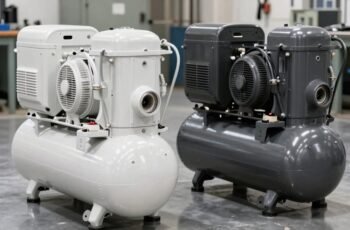
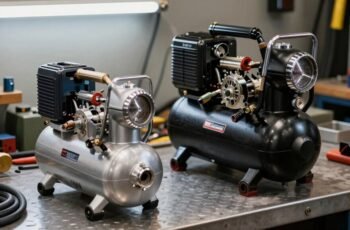
Imagine choosing between a nimble sports car and a rugged pickup truck—each serves a purpose but suits different needs. Similarly, selecting between a pancake air compressor and a hot dog compressor depends on specific project demands. While one offers portability and quick setup, the other provides capacity for extended work. Understanding the technical distinctions and application contexts can substantially influence your choice; let’s explore what makes each compressor type uniquely suited—or not—to your tasks.
Key Takeaways
- Pancake compressors are compact, lightweight, and ideal for quick, intermittent tasks, while hot dog compressors are larger, supporting longer, continuous use.
- Pancake units have smaller tanks (1-6 gallons), suitable for light tasks; hot dog models have bigger tanks (6-20 gallons) for demanding jobs.
- Hot dog compressors generally offer higher CFM and horsepower, making them better for sustained, moderate-demand applications.
- Pancake compressors excel in portability and ease of storage, whereas hot dog models are more durable for extended, moderate workload tasks.
- Maintenance, noise levels, and power sources vary; pancake models are simpler and quieter, while hot dog units are built for durability and extended use.
What Are Pancake and Hot Dog Compressors? An Overview
Pancake and hot dog compressors are two common types of portable air compressors distinguished primarily by their shape and design. Pancake compressors feature a flat, disc-like tank that provides a low-profile profile, making them stable and easy to store. Hot dog compressors, on the other hand, have a cylindrical tank resembling a hot dog, which typically allows for higher capacity and longer runtime. Both designs incorporate electric motors and reciprocating pistons to generate compressed air, but their structural differences influence performance and application. Pancake units generally offer lower air volume and are suitable for light tasks, while hot dog models tend to deliver greater airflow and are better suited for more demanding jobs. Understanding these core design distinctions helps determine their appropriate use cases.
Key Differences in Size, Portability, and Capacity
When comparing pancake and hot dog compressors, their size, portability, and capacity are key factors that influence their practicality for various tasks. Pancake compressors are typically compact, with a low profile and lightweight design, making them highly portable and easy to store. Their small size limits their air tank capacity, generally ranging from 1 to 6 gallons, which restricts continuous use but suits light-duty applications. In contrast, hot dog compressors are more elongated, often with larger tanks that provide increased capacity, often between 6 to 20 gallons. While bulkier, they still maintain portability for mobile workspaces. The capacity differences directly impact operational duration; pancake compressors excel for brief, intermittent tasks, while hot dog models support longer, more demanding operations.
Which Compressor Is Better for DIY Projects?
When evaluating compressors for DIY projects, we focus on portability and size to guarantee ease of transport and storage. Power and performance determine if the compressor can handle varied tasks efficiently, while versatility and compatibility influence its ability to support different tools and attachments. Judging these points helps identify which compressor offers ideal functionality for home use.
Portability and Size
In evaluating portability and size, it’s clear that pancake compressors generally excel for DIY projects due to their compact and lightweight design. Their low profile facilitates easy storage and transport, making them suitable for varied work environments. Conversely, hot dog compressors tend to be larger and heavier, which can hinder mobility but often allow for higher capacity.
Key factors include:
- Dimensions – Pancakes measure around 16 inches or less, fitting into tight spaces.
- Weight – Typically under 30 pounds, easily carried by a single person.
- Design – Horizontal tanks optimize space efficiency.
- Transportability – Handles or wheels on larger models improve maneuverability but add weight.
This analysis highlights that pancake compressors are more practical for frequent, flexible use in DIY settings.
Power and Performance
Power and performance are critical factors when choosing a compressor for DIY projects, as they determine how effectively each unit can handle various tasks. The pancake air compressor generally offers lower horsepower and CFM (cubic feet per minute) ratings, limiting its capacity for continuous or high-demand applications. Conversely, the hot dog compressor typically features higher power outputs and greater CFM, enabling it to sustain more demanding tasks like spray painting or nail gun operation. Efficiency is also a key consideration; a more powerful compressor can cycle less frequently, reducing wear and noise. For DIYers, this means the hot dog compressor provides better performance for extended or intensive use, while the pancake unit suits lighter, occasional tasks. Selecting based on power and performance guarantees the compressor meets the specific demands of your projects.
Versatility and Compatibility
The range of tasks a compressor can handle often hinges on its versatility and compatibility with various tools and accessories. For DIY projects, this factor determines whether a compressor can adapt to different tasks efficiently.
- Portability – Smaller, lightweight models like pancake compressors excel here, enhancing maneuverability for varied projects.
- Air Flow Range – Compatibility with tools requiring different CFM ratings ensures smoother operation across diverse applications.
- Fittings and Attachments – A compressor with standardized fittings offers broader compatibility with a variety of hoses and accessories.
- Power Source Flexibility – Electric versus gas-powered models affect adaptability in different work environments.
Assessing these aspects helps determine which compressor offers the best adaptability for your DIY needs.
Ideal Uses for Pancake Compressors Versus Hot Dog Compressors
Both pancake and hot dog compressors are well-suited for light tasks, but their portability and size make them ideal for small projects. Pancake compressors typically excel in applications requiring consistent pressure over extended periods, while hot dog models offer greater convenience for on-the-go use. Understanding their specific strengths helps determine the best choice for targeted, low-demand tasks.
Suitable for Light Tasks
While pancake compressors are generally more suitable for light tasks, their design and capacity make them especially effective for small-scale applications. Their lower horsepower and limited tank size prioritize quick, intermittent use over continuous operation. For tasks such as inflating tires or powering small pneumatic tools, they offer sufficient pressure and airflow without overextending their capacity.
Key considerations include:
- Short duty cycles — ideal for occasional use rather than prolonged operation.
- Limited CFM output — suitable for tools requiring minimal airflow.
- Low noise levels — advantageous in noise-sensitive environments.
- Portability — facilitating quick setup for minor tasks without the need for heavy equipment.
This makes pancake compressors well-suited for specific, low-demand applications that prioritize convenience and ease of use.
Ideal for Portable Use
Because pancake compressors are designed with portability in mind, they excel in scenarios that require quick setup and ease of transport. Their lightweight, compact form factor allows technicians and DIY enthusiasts to move them easily between job sites or storage locations. The low profile and integrated handle facilitate one-handed carrying, making them ideal for tasks that demand frequent relocation. Additionally, their small footprint enables use in confined spaces where larger units would be impractical. This portability does not compromise performance for intermittent tasks, allowing users to deploy them efficiently in remote locations or for on-the-go repairs. However, their design prioritizes mobility over continuous power output, making them suitable for tasks where portability outweighs prolonged operational capacity.
Best for Small Projects
When selecting an air compressor for small-scale projects, understanding the specific demands of the task helps determine the most suitable type. Pancake compressors excel in precision tasks, where portability and quick setup are priorities, making them ideal for hobbyist repairs and light carpentry. Hot dog compressors, with their larger capacity and higher CFM output, suit small projects requiring continuous airflow, such as spray painting or nailing.
- Pancake Compressors:
- Ideal for intermittent, low-demand tasks
- Portable and lightweight
- Suitable for tool operation over short periods
- Limited tank capacity constrains long-term use
- Hot Dog Compressors:
- Better for consistent, moderate-demand tasks
- Larger tank for extended operation
- Suitable for small but continuous projects
- Slightly less portable but more durable
How to Choose the Right Compressor Based on Your Needs
Selecting the appropriate compressor requires a clear understanding of your specific application and operational demands. Key factors include airflow requirements, pressure needs, and duty cycle. For tasks involving continuous operation or high-volume output, a compressor with higher CFM (cubic feet per minute) and robust durability is essential. Conversely, for intermittent use or low-pressure tasks, a smaller unit suffices. Consider the compressor’s power source—electric or gas—and compatibility with your workspace. Noise levels and portability also influence choice; quieter, lightweight models suit indoor or mobile applications. Evaluating these parameters guarantees you select a compressor that balances capacity, efficiency, and longevity, preventing underperformance or unnecessary wear. A precise assessment of your needs guarantees superior functionality tailored to your specific operational context.
Maintenance Tips to Maximize Your Compressor’s Performance
Regular maintenance plays a vital role in ensuring your compressor operates at peak performance and extends its lifespan. Consistent inspections and servicing prevent efficiency losses and costly breakdowns. To optimize performance, we recommend focusing on these key areas:
- Regularly change the oil and filters to reduce internal wear and maintain airflow.
- Drain moisture from tanks and lines to prevent corrosion and moisture buildup.
- Inspect belts and pulleys for wear and proper alignment, ensuring energy-efficient operation.
- Monitor pressure and temperature gauges to detect irregularities early, avoiding component failure.
Frequently Asked Questions
How Loud Are Pancake and Hot Dog Compressors During Operation?
Pancake compressors typically operate between 70-85 decibels, while hot dog compressors are slightly louder, around 80-90 decibels. We find that both are relatively quiet compared to industrial models, suitable for home and light-duty use.
Can Pancake or Hot Dog Compressors Handle Industrial Tasks?
Remarkably, while pancake and hot dog compressors excel in small tasks, they generally lack the capacity for heavy-duty industrial applications, as their design prioritizes portability and lower power output over continuous, high-demand operation.
What Safety Features Do These Compressors Typically Have?
We find that pancake and hot dog compressors typically include safety features like pressure relief valves, thermal overload protection, and automatic shut-off systems to prevent over-pressurization, overheating, and electrical faults, ensuring safe, reliable operation during use.
Are There Specific Brands Known for Durability in These Models?
We recommend brands like Porter-Cable, California Air Tools, and Campbell Hausfeld for durability in pancake and hot dog compressors, as their builds and components consistently demonstrate long-term resilience and reliable performance in demanding applications.
How Do Energy Efficiencies Compare Between Pancake and Hot Dog Compressors?
Think of energy efficiency as a race; pancake compressors often lead with quicker startups and lower energy consumption, while hot dog compressors may lag slightly behind. We find pancake models generally more efficient for prolonged, continuous tasks.
Conclusion
Ultimately, choosing between a pancake and a hot dog compressor depends on evaluating size, capacity, and task demands. If portability and quick setup are priorities, the pancake compressor offers agility and ease. For sustained, demanding projects, the hot dog compressor provides endurance and capacity. By analyzing your project scope, workspace constraints, and performance needs, you can make an informed decision. Precision, efficiency, and reliability become your guiding principles, ensuring your compressor choice aligns with your craftsmanship and productivity goals.