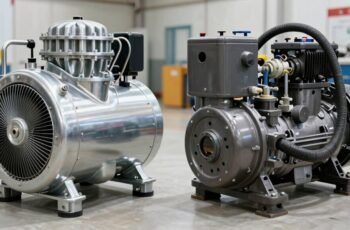
When evaluating air compressors, understanding the trade-offs between silent and standard models is essential for optimizing operational efficiency and environmental considerations. Silent compressors offer benefits in noise-sensitive settings, but may come with different cost and performance implications compared to traditional units. To make an informed choice, we need to analyze their core differences across various parameters. Let’s examine how these distinctions impact practical applications and long-term costs.
Key Takeaways
- Silent compressors operate with noise-dampening features, producing significantly less noise than standard open-frame models.
- Standard compressors prioritize high airflow and power, often generating more noise due to their open design and higher RPMs.
- Silent units are more compact, lightweight, and suitable for noise-sensitive environments; standard compressors are larger and less portable.
- Higher upfront costs of silent compressors are offset by lower energy consumption and reduced maintenance over time.
- Choice depends on environment and task: silent for noise-sensitive settings, standard for high-demand industrial applications.
What Are the Main Differences Between Silent and Standard Air Compressors?
The primary differences between silent and standard air compressors lie in their noise levels, design features, and operational characteristics. Silent compressors utilize sound-dampening enclosures and advanced muffling technology, markedly reducing noise emissions. Their design emphasizes compactness and acoustic insulation, often incorporating vibration isolation to minimize noise transmission. Conversely, standard compressors prioritize performance and airflow capacity, typically featuring open-frame designs with minimal noise control measures. Operationally, silent models often operate at lower RPMs, which reduces mechanical noise but may limit immediate power output. Standard compressors, however, can deliver higher airflow rates but generate more noise due to their open construction and higher operating speeds. These distinctions influence their suitability for different environments, with silent units optimized for noise-sensitive settings and standard models favored for industrial, high-demand applications.
How Does Noise Level Impact Your Work Environment?
Higher noise levels from standard compressors can substantially hinder worker concentration and reduce focus, leading to decreased productivity. Additionally, excessive noise contributes to an uncomfortable work environment, which may cause stress and fatigue. Evaluating noise impacts is essential for optimizing workplace efficiency and overall comfort.
Worker Concentration and Focus
Since noise levels directly influence cognitive performance, understanding how compressor sound emissions affect worker focus is essential in optimizing work environments. Elevated noise from standard compressors can lead to increased cognitive load, impairing concentration and decision-making ability. Continuous exposure to high-decibel sounds induces mental fatigue and distractibility, reducing overall productivity. Conversely, silent or low-noise compressors minimize auditory distractions, allowing workers to sustain attention on complex tasks with greater efficiency. This reduction in noise-related cognitive strain can improve accuracy, decrease errors, and foster a more focused work atmosphere. Analyzing sound emission levels reveals that quieter compressors support sustained mental engagement, highlighting the importance of selecting appropriate equipment to enhance concentration and operational precision within industrial or technical settings.
Overall Workplace Comfort
How considerably does noise level influence overall workplace comfort? Noise impacts comfort by creating stress, reducing productivity, and causing fatigue. Lower noise levels foster a more focused environment, while higher levels cause discomfort and distraction. Specifically, the benefits include:
- Reduced Stress: Quiet environments decrease cortisol levels, improving worker well-being.
- Enhanced Productivity: Less noise minimizes cognitive load, optimizing task performance.
- Better Communication: Lower sound levels improve verbal exchanges and reduce misunderstandings.
In workplaces with loud compressors, ambient noise can lead to increased mental fatigue, impacting overall morale and efficiency. Conversely, silent compressors contribute to a calmer work environment, promoting sustained focus and comfort. The noise level directly correlates with perceived workplace quality, influencing both physical and psychological health of employees.
Which Types of Tasks Are Better Suited for Silent Compressors?
Silent compressors excel in tasks that require minimal noise disruption, making them ideal for environments where sound levels are a critical concern. They are particularly suited for settings like medical facilities, laboratories, or customer-facing service areas, where noise can interfere with concentration or comfort. Additionally, silent compressors are advantageous for precision work, such as assembly lines or electronics manufacturing, where vibration and noise could compromise delicate operations. Their design minimizes sound output without sacrificing performance, making them suitable for continuous or intermittent use in noise-sensitive environments. We find that silent compressors are also beneficial for small workshops or home garages, where disruptive noise can impact daily activities. Overall, tasks demanding quiet operation, precision, or a non-intrusive environment are better suited for silent compressor applications.
What Are the Cost Considerations for Both Compressor Types?
While silent compressors often have higher upfront costs, evaluating their overall expense requires considering long-term savings and operational efficiencies. The initial investment may be significant, but the following factors influence total cost:
Silent compressors may cost more upfront but offer long-term savings through energy efficiency and reduced maintenance.
- Energy Efficiency: Silent compressors typically consume less power due to optimized motor design, reducing ongoing electricity expenses.
- Maintenance Costs: They often require less maintenance because of fewer moving parts and quieter operation, decreasing downtime and repair costs.
- Workplace Impact: Reduced noise levels can minimize the need for soundproofing or protective gear, lowering installation and safety-related expenses.
Assessing these aspects helps determine whether the higher initial investment balances out with savings over the compressor’s lifespan, making silent units a financially viable option in the long term.
How Do Performance and Power Compare in Silent vs. Standard Compressors?
When comparing performance and power, it’s essential to take into account the core operational efficiencies of both compressor types. Silent compressors typically operate with a focus on reduced vibration and noise, which can slightly limit peak power output. Standard compressors prioritize maximum airflow and pressure, often at the expense of noise levels. To illustrate this, consider the table:
| Feature | Silent Compressor | Standard Compressor |
|---|---|---|
| Power Efficiency | Moderate | High |
| Noise Level | Low | High |
| Peak Performance | Slightly Limited | Maximal |
| Operational Stability | Consistent | Variable |
This comparison highlights that silent units excel in steady, quieter operation, while standard models deliver higher raw power and airflow.
What Are the Maintenance and Durability Factors to Keep in Mind?
Maintenance and durability are critical factors influencing the long-term performance of air compressors, and understanding their differences can help inform better selection. Key considerations include:
- Component wear and lifespan: Silent compressors often feature sealed systems that reduce dust ingress, potentially extending component life. Standard compressors, however, may require more frequent inspections of parts like valves and pistons due to exposure to environmental contaminants.
- Lubrication requirements: Silent units typically use oil-free designs, reducing maintenance complexity and risk of oil-related issues. Conversely, oil-lubricated standard compressors need regular oil changes and filter replacements to maintain operational integrity.
- Build quality and materials: Durable construction materials in both types influence longevity, but silent compressors usually emphasize high-quality, corrosion-resistant components to withstand continuous operation with minimal degradation over time.
Which Compressor Offers Better Portability and Space Efficiency?
When comparing portability and space efficiency, size and weight are primary considerations, with silent compressors typically being more compact and lightweight. Noise levels also influence practicality, as quieter units are easier to transport and operate in confined spaces. Additionally, storage requirements differ, impacting how easily each compressor can be integrated into various work environments.
Size and Weight Differences
How do the size and weight of silent air compressors compare to standard models regarding portability and space efficiency? Generally, silent compressors tend to be more compact and lightweight, optimizing for limited space and ease of movement. Specifically:
- Size: Silent units often feature a more streamlined design, reducing footprint to fit into tight workspaces.
- Weight: They typically weigh 20-40% less, making manual transportation easier.
- Design Efficiency: Compact form factors often incorporate vertical or horizontal orientations, maximizing space savings without sacrificing capacity.
This combination of reduced size and weight enhances portability, making silent compressors more adaptable for mobile or confined applications while maintaining performance standards.
Noise Levels Impact Portability
Noise levels considerably influence the portability and usability of air compressors, especially in environments where space and sound restrictions are critical. Silent compressors typically produce markedly lower decibel levels, which enhances their suitability for confined or noise-sensitive settings. This reduced noise output allows for closer placement to work areas without disturbing nearby personnel or occupants, effectively improving operational flexibility. In contrast, standard compressors often emit higher sound levels, necessitating additional soundproofing or remote placement, which can hinder mobility and ease of use. When evaluating portability, the silent compressor’s lower noise footprint translates into fewer logistical constraints, facilitating easier deployment in diverse locations. Consequently, in terms of portability and space efficiency, silent compressors hold a measurable advantage, especially in environments requiring minimal acoustic disruption.
Storage and Space Requirements
Silent compressors generally occupy less space and are designed with compact, integrated components that streamline storage and transport, making them inherently more portable. Their streamlined form factors allow for easier placement in limited spaces, reducing the need for dedicated storage areas. When comparing space requirements:
- Size & Dimensions: Silent units tend to be smaller overall, facilitating easier maneuverability.
- Design Integration: Their integrated tanks and components minimize external attachments, reducing spatial footprint.
- Transport & Storage: Compact size simplifies loading, unloading, and storage, enhancing portability in various environments.
How Do Energy Efficiency and Operating Costs Differ?
While silent air compressors are often marketed for their quiet operation, their energy efficiency and operating costs can differ markedly from standard compressors. Silent models typically incorporate advanced motor designs and optimized airflow pathways, which can reduce energy consumption during continuous operation. However, they often feature higher initial purchase prices, impacting overall cost analysis. Standard compressors, while noisier, usually have lower upfront costs and simpler maintenance requirements, potentially leading to higher long-term operational expenses due to increased energy use and wear. The efficiency gap depends on factors like duty cycle, load variability, and compressor design. Overall, silent compressors may offer improved energy efficiency in steady, low-noise applications, but the cost savings are context-dependent and require detailed assessment of operational parameters.
What Are the Pros and Cons of Investing in a Silent Air Compressor?
Investing in a silent air compressor offers notable advantages, particularly in environments where noise reduction enhances safety, comfort, or productivity. The primary benefit is considerably reduced noise levels, which minimize operator fatigue and improve communication. Additionally, silent compressors often exhibit enhanced durability due to less vibration and lower stress on components. However, there are trade-offs to evaluate.
- Higher initial purchase price compared to standard models.
- Increased complexity in maintenance due to specialized components.
- Limited airflow capacity, which may restrict use in high-demand applications.
While the quiet operation creates a better work environment, the higher upfront costs and potentially limited performance capacity can impact overall cost-effectiveness. Careful assessment of operational needs is essential before investing.
Which Compressor Should You Choose Based on Your Specific Needs?
Choosing the right compressor depends heavily on your specific operational requirements and environment. To determine the best fit, consider factors like noise sensitivity, power needs, and duty cycle. For applications requiring minimal noise, a silent compressor offers quieter operation and reduced disturbance, ideal for indoor or noise-sensitive settings. Conversely, a standard compressor provides higher airflow and durability, suitable for heavy-duty tasks. The table below summarizes key differences:
| Feature | Silent Compressor | Standard Compressor | Ideal Use Case |
|---|---|---|---|
| Noise Level | Low | Higher | Noise-sensitive environments |
| Power & Capacity | Moderate | High | Industrial, heavy-duty applications |
| Maintenance & Cost | Generally higher | Typically lower | Long-term, high-volume use |
Assess your needs carefully to choose the most suitable compressor.
Frequently Asked Questions
How Long Do Silent Compressors Typically Last Compared to Standard Models?
Silent compressors generally last 50% longer than standard models due to reduced wear and lower operating temperatures. We observe lifespans of 10,000 to 15,000 hours, making them more durable and cost-effective over their extended service life.
Are Silent Compressors Suitable for Industrial-Scale Applications?
Silent compressors are generally suitable for industrial-scale applications when noise reduction is critical, but they may require higher initial investment and maintenance considerations. We analyze operational needs carefully to guarantee ideal performance and cost-efficiency in large-scale environments.
What Safety Features Are Common in Silent Versus Standard Compressors?
Like guardians protecting their charge, silent and standard compressors feature safety shut-offs, pressure relief valves, and thermal overload protections. While silent models emphasize noise reduction, both prioritize user safety through rigorous, reliable safety mechanisms.
Can Silent Compressors Operate Continuously Without Overheating?
Silent compressors can operate continuously without overheating if they feature advanced thermal management and adequate cooling systems. We analyze their design, noting that proper ventilation, temperature regulation, and quality components are essential for sustained, safe operation during extended use.
How Does Startup Time Differ Between Silent and Standard Air Compressors?
Silent compressors typically have a longer startup time due to their advanced noise reduction components, but this delay guarantees smoother operation and less stress on the system, making them more reliable over time despite initial startup differences.
Conclusion
In choosing between silent and standard compressors, understanding your environment and task requirements is essential. For example, a dental clinic prioritized noise reduction, opting for a silent compressor, which improved patient comfort and staff concentration. Conversely, an industrial manufacturing facility needed maximum power, favoring a standard model. By analyzing factors like noise, cost, and performance, you can make an informed decision that balances efficiency with operational needs—ensuring maximum productivity and minimal disruption.